
TL;DR:
- Most businesses measure impressions and clicks rather than meaningful business outcomes.
- Performance marketing pays only for measurable actions, ensuring accountability and results.
- Effective execution requires careful measurement, testing, and blending of multiple channels.
Most businesses spending money on digital marketing are measuring the wrong things. Impressions look impressive in a slide deck. Clicks feel like momentum. But neither tells you whether your budget is actually growing your business. Performance marketing exists precisely to fix this. Rather than paying for exposure and hoping for the best, it ties every pound you spend to a concrete, trackable outcome. This guide will walk you through what performance marketing really means, how it works across channels and payment models, how to measure results properly, and what separates the brands that scale from those that simply spend.
Table of Contents
- What is performance marketing?
- How performance marketing works: Channels and models explained
- Measurement, attribution, and the truth behind results
- Real-world applications: Strategies and pitfalls revealed
- Why most marketers misunderstand performance marketing
- Take your performance marketing further with expert support
- Frequently asked questions
Key Takeaways
| Point | Details |
|---|---|
| Outcome-focused marketing | Performance marketing delivers results by linking spend to measurable actions such as sales, leads, or installs. |
| Test and optimise | Blending platforms and running incrementality tests ensures efficiency and avoids wasted budget. |
| Real measurement matters | Understanding true attribution protects your investments from being overstated by 20-40%. |
| Strategy over channels | Choosing the right blend of channels and continually optimising yields the best growth. |
What is performance marketing?
At its core, performance marketing is about accountability. You pay when something measurable happens, not just when your ad appears in front of someone. That shift sounds simple, but it changes everything about how campaigns are planned, run, and evaluated.
Performance marketing is a disciplined, data-driven approach to acquiring, converting, and retaining customers where payment is tied to specific measurable outcomes like clicks, leads, sales, or installs, rather than impressions or reach. That distinction matters enormously for any business that needs to justify its marketing budget.
Traditional digital marketing often operates on a broadcast model. You pay to show an advert, you hope the right people see it, and you attribute any subsequent growth to that activity. Performance marketing flips the model. Every action has a price tag and a measurable return.
The key components that define this approach are:
- Measurability: Every campaign element is tracked. From the first click to the final purchase, data is captured at each stage.
- Bidding and optimisation: Budgets are allocated based on which actions and audiences are producing the best results, and adjusted continuously.
- Clear attribution: Every conversion is linked back to a specific campaign, channel, or creative, so you know what is working.
- Outcome focus: Success is defined by business results, whether that is a completed booking, a qualified enquiry, or a product sale.
“The goal is not to reach as many people as possible. The goal is to reach the right people and pay only when they do what you need them to do.”
For growth-focused businesses in e-commerce, assisted living, and luxury experiences, this model is particularly powerful. You are not gambling on brand awareness. You are investing in outcomes that directly affect occupancy, revenue per customer, or conversion rate. Understanding how digital agencies enable measurable marketing can help you see what a structured approach actually looks like in practice.
How performance marketing works: Channels and models explained
Knowing the definition is one thing. Knowing how to deploy performance marketing across real channels is where strategy begins.
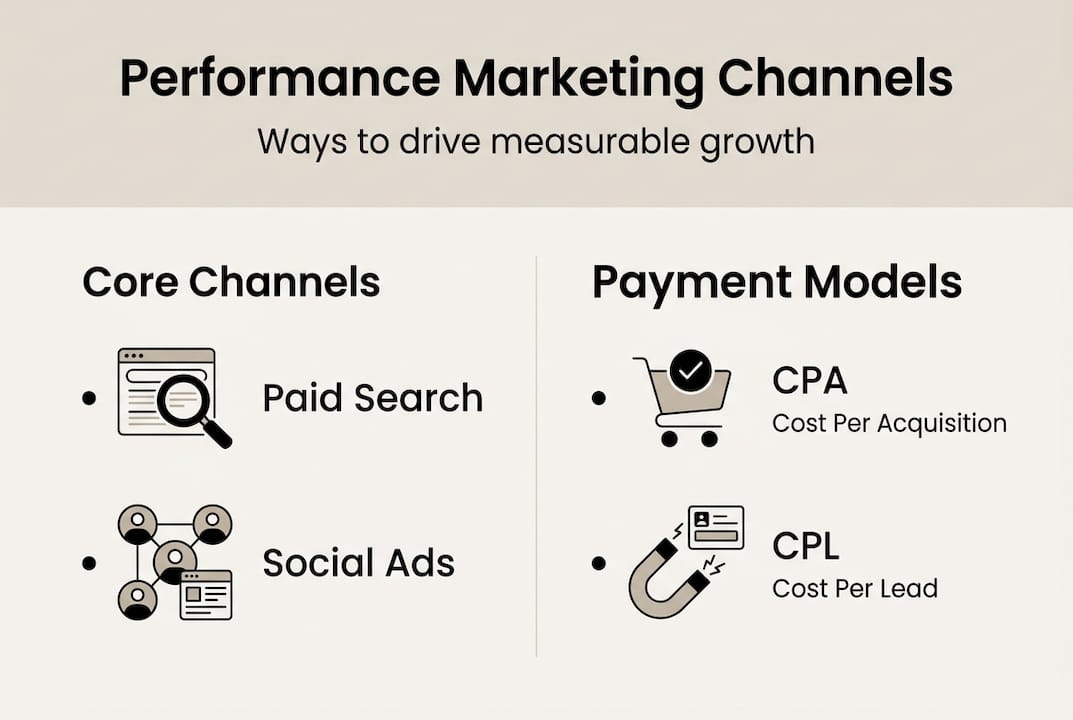
Performance marketing is about payment for measurable, trackable actions and requires a blend of platforms and testing due to changing privacy and signal issues. No single channel gives you the complete picture, which is why the most effective marketers combine several.
The primary channels are:
- Paid search: Adverts on Google and Bing triggered by user intent. High conversion rates because users are already looking for what you offer.
- Paid social: Campaigns on Meta, TikTok, and LinkedIn that use audience targeting to reach specific segments. Excellent for e-commerce and luxury brands building demand.
- Affiliate marketing: Third-party publishers drive traffic and earn a commission only when a specific action is completed. Low risk, but requires careful partner selection.
- Programmatic display: Automated buying of ad placements across websites, using data to target audiences at scale. Works best when combined with strong retargeting strategies.
Common payment models compared:
| Model | What you pay for | Best suited for |
|---|---|---|
| CPA (cost per acquisition) | Completed sale or sign-up | E-commerce, lead generation |
| CPL (cost per lead) | Qualified enquiry submitted | Assisted living, B2B |
| CPM (cost per thousand impressions) | Reach with outcome tracking | Awareness with retargeting |
| Revenue share | Percentage of sale value | Affiliates, partnerships |
The right model depends on your business type and margin. Assisted living facilities, for example, benefit most from CPL campaigns because each qualified enquiry has a predictably high lifetime value. E-commerce brands scaling to £50k per month and beyond often start with CPA models before shifting to revenue share agreements with affiliate partners.

Pro Tip: Do not commit your entire budget to one channel. Start with paid advertising for performance marketing across two or three platforms, then scale the channel producing the lowest cost per action. This also protects you from signal loss when platforms update their privacy policies.
Blending data sources is not optional. It is what separates consistent performers from those who see results spike and then plateau. Look at targeted advertising strategies to understand how audience segmentation improves performance across every model.
Measurement, attribution, and the truth behind results
Here is where most marketing teams run into serious trouble. They assume that because performance marketing is data-driven, the data they see is accurate. It frequently is not.
Incrementality tests reveal 20-40% overstatement in attribution, meaning the conversions your platform claims credit for are often inflated. Customers who would have purchased anyway get counted as campaign wins. That distortion pushes budgets towards channels that look productive but are actually claiming credit for organic demand.
Common attribution models and their limitations:
| Attribution model | How it works | Key limitation |
|---|---|---|
| Last-click | Credits the final touchpoint before conversion | Ignores all earlier interactions |
| Multi-touch | Spreads credit across multiple touchpoints | Weighting is often arbitrary |
| Data-driven | Uses machine learning to assign credit | Requires large data volumes to be reliable |
Privacy changes have made this harder. Cookie deprecation, iOS tracking restrictions, and GDPR compliance have all reduced the signal quality that platforms rely on. Meta and Google now model conversions they cannot directly observe, which means their reported numbers include educated estimates.
The solution is a blended measurement approach:
- Use platform data as a directional signal, not absolute truth.
- Run regular incrementality experiments to test whether switching off a campaign actually reduces results.
- Supplement with marketing mix modelling (MMM) for a top-down view of channel contribution.
- Track data-driven campaign optimisation through your own first-party data wherever possible.
Understanding ad spend and ROI insights becomes essential once you accept that platform-reported numbers need scrutiny. The brands that grow sustainably are those that invest in proper measurement infrastructure, not just campaign execution.
For context on how the measurement landscape is shifting in 2026, reviewing digital marketing trends and attribution will give you a sharper sense of where best practice is heading.
Real-world applications: Strategies and pitfalls revealed
Performance marketing theory means nothing without execution. Here is how it translates into practical action for the sectors that benefit most.
Getting started and scaling effectively:
- Define your target cost per action before you launch. Know your margins and what you can afford to pay for a lead or sale.
- Set up conversion tracking across every relevant channel. If you cannot measure it, you cannot optimise it.
- Launch on two to three channels simultaneously with small test budgets. Gather at least four weeks of clean data before drawing conclusions.
- Identify your lowest-cost performing channel and shift budget accordingly, while continuing to test creative and audience variations.
- Run your first incrementality test within the first 90 days to validate whether campaigns are genuinely driving new revenue.
Sector-specific examples:
An e-commerce brand selling premium goods might combine Google Shopping (CPA model) with Meta prospecting campaigns (CPM with retargeting) and an affiliate programme for review sites. Each channel plays a different role in the customer journey.
An assisted living facility in the UK or US benefits from CPL campaigns on Google, targeting families searching for care options. The cost per qualified lead is higher than most sectors, but the lifetime value of a single resident makes even a £200 CPL extremely profitable.
A luxury retreat brand needs to be careful not to devalue its positioning through broad performance campaigns. High-value, intent-driven paid search combined with carefully curated social targeting performs far better than volume-led approaches.
“Performance marketing requires ongoing optimisation and blending of methods for reliable results.”
Common pitfalls to avoid:
- Over-relying on a single platform’s reported data without independent validation.
- Pausing campaigns too quickly when results dip, without understanding seasonality or attribution lag.
- Ignoring creative quality. Even the best bidding strategy fails with weak ad creative.
Pro Tip: Review your conversion tactics that work alongside your performance data. Poor landing page experience accounts for a significant share of wasted ad spend, and fixing it costs nothing compared to increasing your budget.
Why most marketers misunderstand performance marketing
The biggest mistake we see, repeatedly, is brands treating performance marketing as a tap they can turn on and off. They run campaigns for six weeks, see encouraging platform numbers, call it a success, and then either scale recklessly or cut budget at the first sign of fluctuation.
The inconvenient truth is that first-attribution results are often misleading. A brand might credit Google Search with 80% of its conversions while Meta quietly influencing the customer journey goes largely unaccounted for. Chasing that Google number leads to underinvestment in channels that genuinely build demand.
Sustainable performance marketing is built on a culture of testing and honest measurement, not on trusting whichever platform tells the most flattering story. Brands that scale well tend to prioritise incrementality, empower their teams to run experiments, and are willing to accept that not every result will look clean. Applying optimising strategies for high-conversion brands consistently, rather than reactively, is what separates genuinely high-performing marketing operations from those that just look good on a dashboard.
Take your performance marketing further with expert support
Understanding performance marketing is one thing. Building a system that executes it reliably, across the right channels, with proper measurement in place, is another challenge entirely.

At NU Life Digital, we build performance marketing ecosystems for e-commerce brands, assisted living providers, and luxury experience businesses that are serious about growth. From performance-focused web design that converts your paid traffic into real revenue, to paid advertising expertise that keeps cost per acquisition under control, every element of what we do is tied to measurable outcomes. If you are ready to move beyond clicks and impressions, explore our optimisation for e-commerce brands and see what a properly built growth engine looks like.
Frequently asked questions
How is performance marketing different from traditional digital marketing?
Performance marketing only pays for measurable actions such as sales or leads, not just for exposure, making it far more accountable than traditional digital marketing. Traditional approaches often prioritise reach, whereas performance marketing ties payment directly to outcomes.
Which channels are most effective for performance marketing?
Paid search, social advertising, affiliates, and programmatic display are among the most effective channels for performance-driven outcomes. The best results come from combining channels rather than relying on one, as measurable, trackable actions require a blend of platforms to capture the full customer journey.
Why are incrementality tests important in performance marketing?
Incrementality tests reveal whether marketing activity truly drives new results or simply claims credit for purchases that would have happened anyway. Without them, brands risk acting on 20-40% overstated attribution data and misallocating significant budget.
What is the first step to adopting performance marketing?
Set clear, measurable goals and select channels that allow you to track cost per action before committing budget. A disciplined, data-driven approach to defining success metrics from the outset prevents wasted spend and gives campaigns a fair opportunity to prove their value.
Recommended
- Why paid advertising drives measurable business growth – Nu Life Digital
- Paid advertising strategies that drive maximum ROI – Nu Life Digital
- Scalable marketing: achieve sustainable growth in 2026 – Nu Life Digital
- Unlock growth with multi-channel advertising: a guide – Nu Life Digital
- Cum sa folosesti Performance Max pentru a-ti creste vanzarile – Devrika