
TL;DR:
- Multi-channel advertising expands reach and reduces risk by targeting audiences across various platforms.
- Different channels serve distinct stages of the customer journey, from awareness to conversion.
- Successful strategies focus on demand generation, consistent messaging, and data-driven optimization.
Most marketing managers assume that spreading spend across more channels automatically grows the business. It rarely does. Without a clear framework, multi-channel advertising becomes an expensive experiment where budget leaks across platforms with little to show for it. The good news is that when you approach it strategically, advertising across multiple channels genuinely accelerates customer acquisition and improves ROI. This guide covers what multi-channel advertising actually is, how each channel fits into the customer journey, how to build a strategy that works, and the mistakes most brands never realise they’re making.
Table of Contents
- What is multi-channel advertising?
- How different channels power each stage of the customer journey
- Building an effective multi-channel advertising strategy
- Common mistakes and how to avoid them
- Why most brands misuse multi-channel and how to get it right
- Ready to multiply your results with strategic support?
- Frequently asked questions
Key Takeaways
| Point | Details |
|---|---|
| Channel roles matter | Prioritise channels by their core strength—reach, engagement, or conversion—for better results. |
| Coordination is critical | Unifying your data and messaging across platforms boosts effectiveness and ROI. |
| Watch for common mistakes | Avoid over-investing in one stage or spreading your budget too thin. |
| Measure what matters | Base decisions on cross-channel performance, not isolated channel results. |
What is multi-channel advertising?
At its core, multi-channel advertising means deliberately reaching your target audience across several distinct platforms. Think search engines, social media, email, display networks, and video. Each platform operates independently, with its own budget, targeting logic, and creative format. The goal is simple: be present wherever your ideal customer is most likely to engage.
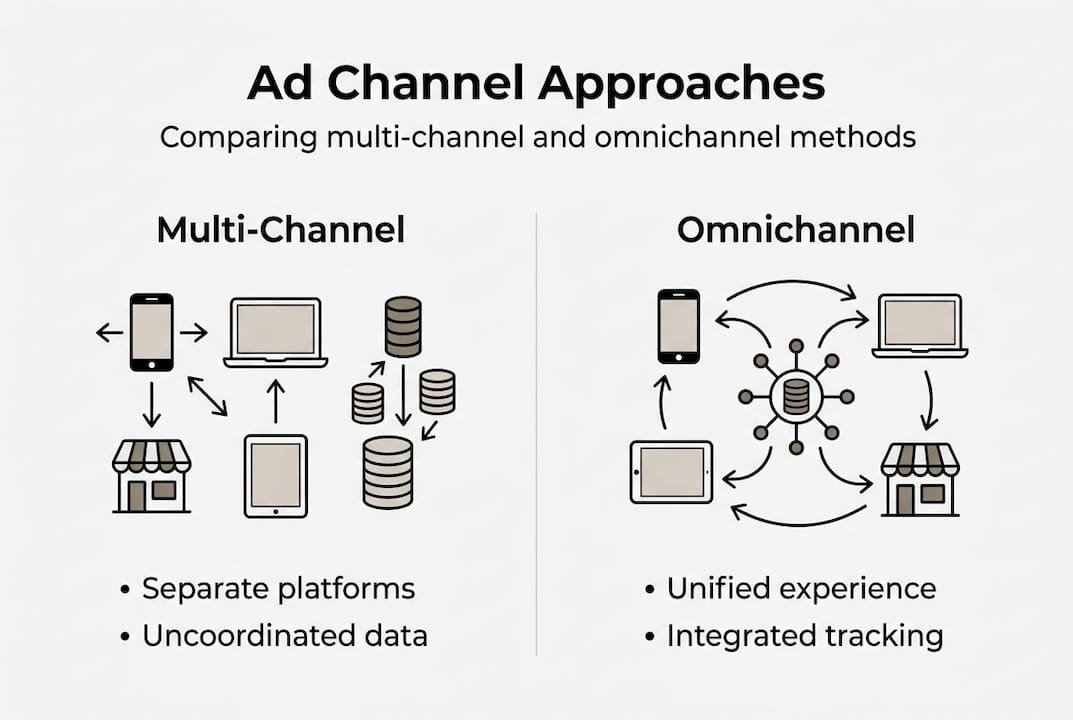
It’s worth understanding how this differs from single-channel and omnichannel approaches. The table below makes this clear.
| Approach | Definition | Key characteristic |
|---|---|---|
| Single-channel | One platform only (e.g., Google Ads) | Simple but high risk |
| Multi-channel | Multiple platforms, managed separately | Greater reach, more data |
| Omnichannel | Platforms integrated for a seamless experience | Unified journey, higher complexity |
If you want to understand omnichannel marketing explained in depth, it is a meaningfully different discipline. Multi-channel and omnichannel are often confused, but as the distinction clarifies, multi-channel keeps channels largely separate while omnichannel coordinates them into a single, fluid customer experience.
For most growing businesses, multi-channel is the practical starting point. Here is why it matters:
- Greater reach: Different audiences favour different platforms. Covering more ground increases your chances of being found.
- Risk mitigation: If one channel underperforms or faces policy changes, others keep driving results.
- Richer data: Multiple channels generate more behavioural signals, giving you better material for audience optimisation.
- Audience building: Consistent exposure across touchpoints increases brand recall and trust.
The key building blocks are audience targeting, consistent messaging, and coordinated campaign planning. Without all three, you have activity, not strategy.
How different channels power each stage of the customer journey
Every channel has a job. The mistake many brands make is treating all channels as conversion tools, when in reality they serve very different stages of the customer journey.
Social media and video platforms such as Meta and YouTube are strongest for awareness. They reach people who do not yet know they have a problem you solve. Content marketing and email sit in the middle of the funnel, nurturing warm audiences who are aware but not yet ready to buy. Search and retargeting channels are where conversion happens. These are bottom-funnel tools that capture demand that already exists.
| Channel | Main purpose | Typical KPIs |
|---|---|---|
| Social (Meta, TikTok) | Awareness and reach | Impressions, reach, CPM |
| Video (YouTube) | Awareness and consideration | View rate, watch time |
| Content and email | Engagement and nurture | Open rate, time on page |
| Search (Google Ads) | Conversion and intent | CPC, conversion rate |
| Retargeting (display) | Conversion and recovery | ROAS, CPA |
To know which channels suit your specific goals, work through these questions:
- Where does my audience spend the most time online?
- What stage of awareness are they at before finding me?
- What is my budget, and which channels require more spend to show results?
- Do I have the creative assets to compete on visual platforms like Instagram or YouTube?
- What KPIs matter most to my business right now: reach, leads, or revenue?
As the evidence around channel role prioritisation consistently shows, over-investing in lower-funnel channels produces diminishing returns because it drains the audience pool feeding those channels in the first place. If you want to maximise ROI with paid advertising, building demand upstream is not optional. It is foundational.
The brands that win are not those spending the most on conversion campaigns. They are the ones who have enough warm demand at the top to keep those conversion campaigns profitable.
Understanding what omnichannel means also helps contextualise why the journey matters so much. When channels are even loosely coordinated, conversion rates improve because audiences experience a coherent message across touchpoints.
Building an effective multi-channel advertising strategy
Understanding each channel’s function is vital, but orchestrating them well is how you unlock true growth. Strategy is not a document you write once. It is a living system you adjust constantly.

Start by defining goals and KPIs before touching a single budget. A common failure is launching campaigns across five platforms with no agreed definition of success. Your strategy workflow guide should map every channel to a specific stage of the funnel and a measurable outcome.
From there, coordinate your messaging. Consistency does not mean identical ads everywhere. It means the same core value proposition delivered in the right format for each platform. A LinkedIn ad will look very different from a retargeting banner, but they should feel like they come from the same brand.
Data unification is where most businesses fall short. When your ad platforms, CRM, and website analytics operate in silos, you cannot see the full picture. Using a Customer Data Platform (CDP) to centralise your audience data is a game-changer. As suppression and lookalike data demonstrate, unified data allows you to suppress existing customers from acquisition campaigns and build lookalike audiences, improving ROAS significantly.
Pro Tip: Once your CDP or CRM is connected to your ad platforms, build suppression lists that exclude recent buyers from acquisition campaigns. This alone can cut wasted spend by 20 to 30 per cent.
Key essentials for a working multi-channel strategy:
- Set clear channel-specific KPIs tied to your overall business goals
- Use a shared creative brief to keep messaging consistent across all platforms
- Integrate your SEO strategies for growth with paid channels to reduce total cost per acquisition
- Review high-ROI advertising tips to sharpen targeting across each platform
- Analyse cross-channel performance weekly, not monthly
Common mistakes and how to avoid them
A strong strategy must also be proactive about what could go wrong. Most multi-channel campaigns do not fail because of poor creative. They fail because of structural problems in how the strategy is built and measured.
Here are the four most damaging mistakes, and how to fix each one:
- Spreading budget too thin: Running on six channels with a modest budget means no single channel has enough spend to optimise properly. Fix: Start with two or three channels and scale once each is profitable.
- Measuring channels in silos: Judging each channel by last-click conversions misses how channels influence each other. Fix: Use multi-touch attribution models to understand the full contribution of each platform.
- Inconsistent branding across channels: When your Facebook ads look nothing like your Google display ads, trust erodes. Fix: Create a channel-agnostic creative brief that defines tone, visuals, and messaging hierarchy before production begins.
- Over-focusing on bottom-funnel tactics: The lower-funnel bias pitfall is real. Pouring budget into retargeting and search while neglecting awareness channels gradually depletes the audience pool those conversion campaigns rely on. Fix: Allocate at least 30 to 40 per cent of your budget to top-funnel demand generation.
Pro Tip: Set a quarterly audit date. Review both spend allocation and creative performance across every active channel. Stale creative and imbalanced budgets are two of the most common reasons strong strategies quietly stop working.
Connecting your effective strategy workflow to your measurement framework is what keeps these problems from creeping back in. Staying ahead of top trends for 2026 also ensures your channel mix evolves as platform algorithms and user behaviour shift.
Why most brands misuse multi-channel and how to get it right
Here is what years of working with growth-stage businesses reveals: the problem is almost never the channels themselves. It is the assumptions brands bring to them.
Conventional wisdom treats every platform as a potential conversion machine. That mindset leads to over-bidding on search, excessive retargeting, and near-zero investment in brand building. The result? Short-term revenue that flatlines within six to twelve months because there is no new demand entering the top of the funnel.
One pattern we see repeatedly: a business triples its retargeting spend, sees a quick ROAS spike, then watches performance collapse two quarters later. Why? The warm audience was exhausted. There was no upstream investment to replenish it.
The reset we recommend to brand managers has three steps. First, audit your current spend split and ask honestly what percentage is going to awareness versus conversion. Second, redistribute at least 30 per cent to demand generation channels even if the direct attribution looks weaker. Third, give it 90 days before judging results, because brand channels operate on a slower feedback loop.
Quality over quantity is not a cliché here. Three channels executed with precision will always outperform seven channels managed with divided attention. As the evidence behind ROI-maximising strategies consistently supports, disciplined channel selection beats broad coverage every time.
Ready to multiply your results with strategic support?
Armed with this knowledge, your next step is to put it into action, and that is where we come in.
At NU Life Digital, we build the full growth ecosystem: the strategy, the channels, the creative, and the measurement framework that ties it all together. Whether you are scaling an e-commerce brand or managing enquiries for an assisted living facility, we design multi-channel systems that deliver measurable, consistent returns. Our approach to paid ad strategies is built around real ROI, not vanity metrics. If your current advertising feels like guesswork, we can fix that.
Frequently asked questions
How does multi-channel advertising differ from omnichannel?
Multi-channel advertising uses several platforms but manages them separately, while omnichannel integrates those platforms for a seamless, unified customer experience across every touchpoint.
What is the biggest mistake brands make with multi-channel advertising?
Many brands over-focus on bottom-funnel channels, and the lower-funnel bias consequence is a gradual depletion of the demand pool that conversion campaigns depend on to stay profitable.
Which channels are best for generating conversions?
Search and retargeting typically deliver the highest conversion rates, but as search and retargeting research shows, they perform best when supported by upstream brand-building activity.
How can I measure if my multi-channel approach is working?
Track cross-channel KPIs that connect to your central business goals rather than siloed platform results, and review spend and messaging allocation at least monthly to stay on course.
Recommended
- Paid advertising strategies that drive maximum ROI – Nu Life Digital
- Top strategies to optimise e-commerce brands for higher conversions – Nu Life Digital
- Why paid advertising drives measurable business growth – Nu Life Digital
- Scalable marketing: achieve sustainable growth in 2026 – Nu Life Digital