
TL;DR:
- A disciplined, structured framework is essential for effective paid advertising campaigns.
- Proper account setup, clear goals, and ongoing optimization drive scalable results.
- Regular monitoring and iteration prevent campaign stagnation and maximize return on ad spend.
Investing money in paid advertising without a clear process is one of the fastest ways to burn through your budget and miss every growth target you’ve set. Many marketing managers in e-commerce brands and assisted living facilities find themselves in exactly this position: campaigns running, money leaving the account, but no coherent system behind it. The result is unpredictable returns, frustrated stakeholders, and a growing scepticism about whether paid ads work at all. They do work. But only when they’re built on a disciplined, repeatable framework. This guide walks you through exactly that, from setting objectives to automating optimisation, so you can scale with confidence.
Table of Contents
- Defining your objectives and prerequisites
- Structuring your campaign: The ABCs model
- Execution: Launch, optimise and automate
- Monitoring, troubleshooting and iterating for better results
- Our perspective: Why structure trumps tactics in paid advertising
- How Nu Life Digital can help you scale paid advertising
- Frequently asked questions
Key Takeaways
| Point | Details |
|---|---|
| Set clear objectives | Define business goals and campaign KPIs before launching paid advertising. |
| Structure campaigns methodically | Use the ABCs model for accounts, budgets and campaigns to maintain clarity and control. |
| Leverage automation | Smart Bidding and AI optimisation are now essential for efficiency and growth. |
| Monitor and iterate | Regular review and agile changes boost long-term performance and ROI. |
Defining your objectives and prerequisites
Before a single penny leaves your ad account, you need absolute clarity on what success looks like. Vague goals like “get more traffic” or “increase awareness” are not measurable, and they certainly don’t help you make decisions when performance dips. Start by aligning your campaign goals directly with your broader business targets. Are you trying to increase product sales to hit a monthly revenue figure? Are you filling enquiry pipelines for an assisted living facility? Your answer shapes everything: the platform you use, the audience you target, and the way you measure results.
Once your goal is clear, define your core KPIs upfront. For e-commerce, this typically means return on ad spend (ROAS), cost per purchase, and conversion rate. For assisted living, it’s more likely cost per lead, enquiry volume, and lead quality score. Write these down and share them with everyone involved before launch. Ambiguity at this stage creates conflict later.
Next, audit your prerequisites. Running a campaign without these in place is like launching a product without a checkout page:
- Budget: Know your monthly ceiling and your acceptable cost per result
- Creative assets: Images, videos, copy, and landing pages must be ready before you go live
- Tracking setup: Google Tag Manager, conversion pixels, and analytics must be firing correctly
- Team skills: Identify who owns campaign management, creative iteration, and reporting
- AI tools: Smart bidding and audience tools are now core prerequisites for advertising success
| Prerequisite | E-commerce priority | Assisted living priority |
|---|---|---|
| Conversion tracking | Critical | Critical |
| Creative assets | High | Medium |
| Landing page CRO | High | High |
| AI bidding tools | High | Medium |
| Budget framework | Medium | High |
Building your digital marketing strategy workflow before campaign launch saves weeks of reactive firefighting later.
Pro Tip: Run a cross-team kick-off meeting before launch. Bring together marketing, sales, and operations to surface any bottlenecks, from broken tracking to missing creative approvals, before they derail your first week of spend.
Structuring your campaign: The ABCs model
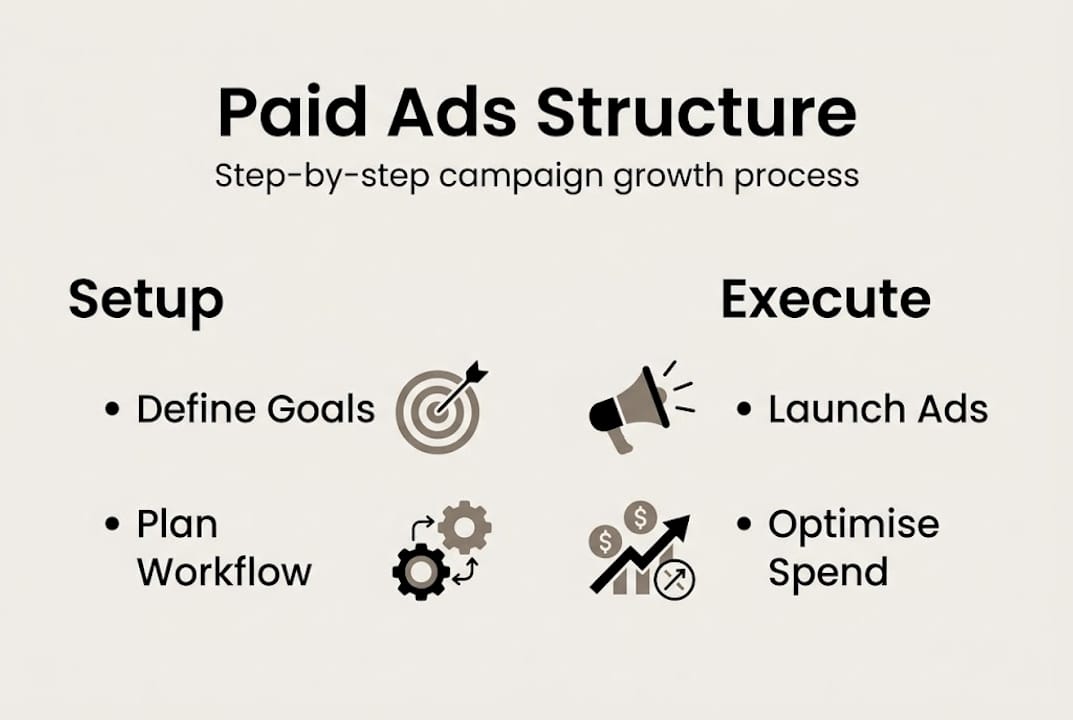
Once your foundation is solid, the way you organise your campaigns determines how much control and clarity you’ll have as they scale. The ABCs model, which stands for Accounts, Budgets, and Campaigns, is advocated by Google as the standard for structuring paid advertising with long-term efficiency in mind.
Here’s how to apply it step by step:
- Accounts: Decide whether you need a single account or multiple accounts. A single Shopify brand with one target market typically runs well from one account. A multi-region assisted living group, however, benefits from separate accounts per location to keep data clean and budgets accountable.
- Budgets: Allocate spend based on two factors: revenue impact and testing priority. High-converting product lines or high-demand care services get the largest share. A portion, typically 15 to 20 per cent, should always be reserved for testing new audiences or creative formats.
- Campaigns: Break your campaigns out by product category, audience segment, or geographic region. Avoid the common mistake of lumping everything into one campaign. Granularity gives you the data to make confident decisions.
| Approach | Best for | Key advantage |
|---|---|---|
| Single account | Small e-commerce brands, single-site care facilities | Simplicity, unified reporting |
| Multi-account | Multi-location businesses, large product catalogues | Budget isolation, cleaner data |
Effective strategies for paid ad ROI almost always involve deliberate account architecture, not ad-hoc campaign creation.

For targeted paid advertising to work at scale, naming conventions matter more than most managers realise. A campaign called “Google Search UK Care Homes Retargeting April 2026” tells you platform, market, intent, audience, and timing at a glance.
Pro Tip: Build a campaign naming template and make it mandatory across your team. It sounds trivial but saves enormous time when diagnosing issues or reporting to stakeholders across dozens of active campaigns.
Execution: Launch, optimise and automate
With your structure confirmed, the focus shifts to launching with discipline and building optimisation into your weekly rhythm from day one. A common mistake is treating launch as the finish line. It’s actually just the starting pistol.
Follow these steps when going live:
- Use proven creative templates with clear value propositions. For e-commerce, lead with product benefits and urgency. For assisted living, lead with empathy, trust signals, and a specific call to action.
- Apply UTM tracking parameters to every URL so you can trace performance back to individual ads and audiences in your analytics platform.
- Activate Smart Bidding from the outset where you have sufficient conversion data. Smart Bidding and Performance Max campaigns are Google’s recommended approach for driving growth and efficiency at scale.
- Set automated budget alerts so you’re never caught off-guard by overspend.
Businesses using AI tools for advertising and Google’s AI Essentials framework see up to 30% higher conversion rates compared to manually managed campaigns running without automation.
Your quick-win optimisation checklist for the first two weeks:
- Add negative keywords to block irrelevant traffic immediately
- Enable all relevant ad extensions (sitelinks, callouts, structured snippets)
- Check budget pacing daily to ensure spend is distributed evenly
- Review search term reports every three days early on
- Test at least two ad variants per ad group to generate creative data
For ad spend optimisation, the biggest lever available to most teams is simply removing wasted spend through disciplined negative keyword management and tighter audience exclusions.
Monitoring, troubleshooting and iterating for better results
Running campaigns is not a set-and-forget activity. The businesses that generate compounding returns from paid advertising are those that treat monitoring as a core operational habit, not an afterthought.
Build these routines into your team’s calendar:
- Daily: Check cost, conversions, and any anomalies in Google Ads’ dashboard
- Weekly: Review ad group performance, audience insights, and creative fatigue indicators
- Fortnightly: Assess landing page conversion rates alongside ad performance
- Monthly: Full strategic review against business objectives and budget allocation
Common errors that quietly erode campaign performance include:
- Missed conversions due to broken tracking or incorrect attribution windows
- Budget over-runs caused by broad match keywords without adequate negative lists
- Creative fatigue, where audiences stop responding to the same ad after repeated exposure
- Poorly defined audience segments leading to low-quality clicks that don’t convert
Using Google Ads’ reporting tools and AI-driven insights surfaces these issues before they become expensive problems. The Recommendations tab and automated alerts are particularly useful for catching performance drops early.
The campaigns that consistently outperform the competition are not the ones with the most creative ideas. They’re the ones built on a relentless cycle of analyse, optimise, and repeat. Iteration is the strategy.
Pro Tip: Block out one hour every month for a structured strategy review. Compare current KPIs against your original objectives, revisit audience assumptions, and decide which tests to carry forward. This single habit is what separates teams that scale from those that stagnate.
For teams focused on growth, pairing strong ad performance with a plan to boost online sales through landing page and checkout improvements compounds the impact of every pound you spend. Strong conversion optimisation strategies amplify what your paid campaigns deliver.
Our perspective: Why structure trumps tactics in paid advertising
We see it repeatedly. A marketing team gets excited about a new ad format, a trending audience strategy, or a bidding hack they read about online. They chase it. Results spike briefly, then fade. And they’re back to square one.
The uncomfortable truth about measurable business growth through paid advertising is that tactics alone never sustain it. Ad fatigue sets in quickly with ad-hoc campaigns that lack coherent structure. Diminishing returns follow shortly after.
What actually works, consistently, is treating your paid advertising setup as a replicable system rather than a collection of one-off experiments. When your account architecture is logical, your naming conventions are clean, your testing cadence is consistent, and your reviews are scheduled, you build an asset. Not just a result. That system can be handed to a new team member, scaled into new markets, or adapted for new products without starting from scratch. Structure is not the boring part of advertising. It is the part that makes everything else work.
How Nu Life Digital can help you scale paid advertising
Ready to stop guessing and start building a paid advertising engine that actually compounds over time?

At NU Life Digital, we implement the exact frameworks covered in this guide, from account architecture and AI-powered bidding to ongoing optimisation and reporting. Our paid advertising ROI strategies are built for e-commerce brands and assisted living facilities that want structured, scalable growth. Whether you need a full campaign audit, help implementing automation, or a managed ads service from the ground up, our team covers every phase. Speak with one of our expert consultants or explore our AI integration services to see how we can build your growth engine today.
Frequently asked questions
What is the first step in launching a paid advertising campaign?
Start by clearly defining your business objectives and campaign KPIs, then assemble your team and creative resources. Detailed preparatory work before launch is what Google’s best practices consistently emphasise for campaign success.
How does Smart Bidding improve campaign results?
Smart Bidding uses AI to optimise bids in real time, often delivering higher conversions at a lower cost per result. Google recommends automation as the most effective route to sustained campaign efficiency.
How often should I monitor and adjust campaigns?
Monitor daily for key metrics and conduct deeper strategic reviews monthly to maximise ROI. Google Ads’ reporting tools are designed to support exactly these regular review cycles.
Should smaller budgets use AI-powered tools in paid advertising?
Yes, AI tools help all advertisers regardless of budget by enabling smarter targeting and more efficient spending. Google’s AI Essentials framework is specifically recommended for all account sizes, not just large spenders.
Recommended
- Paid advertising strategies that drive maximum ROI – Nu Life Digital
- Why paid advertising drives measurable business growth – Nu Life Digital
- What is targeted paid advertising? 5 high-ROI strategies – Nu Life Digital
- Step-by-step conversion rate optimisation guide: grow revenue – Nu Life Digital
- Status 200 Uploads — Schedule Posts to TikTok, Instagram, FB, YouTube, X & LinkedIn