



Most business owners pour money into driving traffic to their website, then wonder why revenue stays flat. The truth is, traffic without conversion is just noise. Small changes in conversion rates can have a dramatic impact on revenue, yet conversion optimisation remains one of the most overlooked growth levers available to assisted living providers and e-commerce brands alike. This guide walks you through what website conversion really means, why it matters more than traffic volume, and exactly how to improve it for sustainable, measurable growth.
Table of Contents
- What is website conversion and why does it matter?
- The link between conversion rates and revenue growth
- Common barriers to high website conversion
- Actionable strategies for boosting website conversion
- Measuring and tracking website conversion for sustainable growth
- Unlock next-level website conversion with expert help
- Frequently asked questions
Key Takeaways
| Point | Details |
|---|---|
| Conversion drives revenue | Improving website conversion directly boosts business income regardless of traffic levels. |
| Identify and fix barriers | Address common obstacles like unclear messaging and poor design to increase conversions. |
| Implement proven tactics | Practical strategies such as improving calls to action and site speed raise conversion rates. |
| Continuous measurement | Tracking and benchmarking conversion rates ensures ongoing growth and optimisation. |
| Sector-specific priorities | Assisted living prioritises trust; e-commerce aims for seamless purchasing — tailor your approach accordingly. |
What is website conversion and why does it matter?
At its core, conversion means turning visitors into customers, leads, or residents. It sounds simple, but most businesses misunderstand what counts as a conversion and, more importantly, how to measure it properly.
A conversion is any desired action a visitor takes on your website. The type of conversion depends entirely on your business model:
- Form submissions (enquiries, contact requests, callback forms)
- Purchases (e-commerce transactions, product sales)
- Bookings (tours, consultations, admissions for assisted living facilities)
- Phone calls triggered by a click-to-call button
- Email sign-ups or content downloads
For an assisted living facility, a conversion might be a family member submitting an enquiry form after viewing your care options page. For an e-commerce brand, it is a completed checkout. Both are equally valuable, and both are measurable.
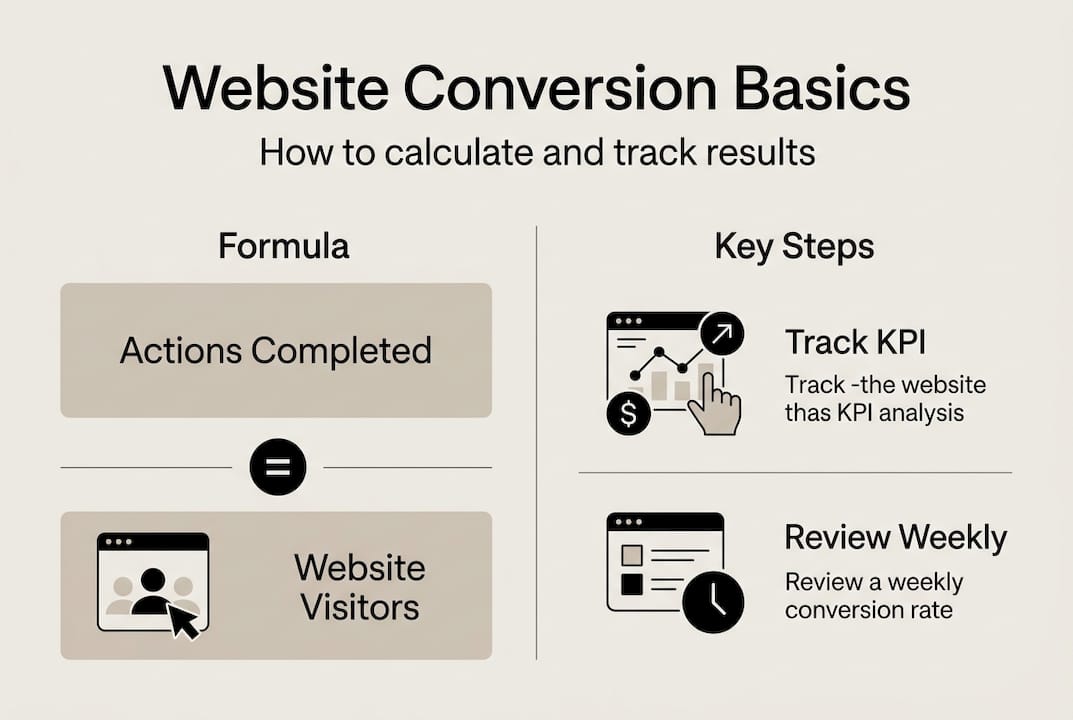
The conversion rate formula is straightforward. Divide the number of completed actions by the total number of website visitors, then multiply by 100. If 2,000 people visit your site and 40 submit an enquiry, your conversion rate is 2%. That single number tells you more about your website’s performance than total traffic ever could.
Many businesses focus on growing traffic through paid ads or SEO, assuming more visitors automatically means more revenue. It does not. A website converting at 1% with 10,000 monthly visitors produces 100 leads. Improve that rate to 3% without changing your traffic, and you have 300 leads. The digital agency impact of focusing on conversion rather than traffic alone is often the difference between stagnation and real growth.
Pro Tip: Always track your conversion rate as a primary KPI, not just total sales or enquiries. A rising conversion rate signals that your website is genuinely improving, regardless of traffic fluctuations.
The link between conversion rates and revenue growth
With a clear definition in mind, let us break down how conversion rates directly translate into increased revenue for your business.

Even a 1% increase in website conversion can significantly raise income without spending an extra penny on advertising. Consider two businesses with identical monthly traffic of 5,000 visitors.
| Metric | Business A | Business B |
|---|---|---|
| Monthly visitors | 5,000 | 5,000 |
| Conversion rate | 1% | 3% |
| Conversions per month | 50 | 150 |
| Average value per conversion | £200 | £200 |
| Monthly revenue | £10,000 | £30,000 |
Same traffic. Three times the revenue. That is the power of conversion optimisation done properly.
For assisted living providers, each additional enquiry represents a potential long-term resident. The lifetime value of a single resident placement can run into tens of thousands of pounds annually. For e-commerce brands working towards e-commerce growth solutions, even modest improvements in checkout conversion can compound into significant monthly revenue gains.
“Conversion rate improvements deliver compounding returns. Unlike paid traffic, which stops the moment you stop spending, a better-converting website keeps working for you around the clock.”
The key distinction here is sustainability. Paid advertising can spike your traffic, but if your website does not convert, you are simply burning budget. Investing in conversion optimisation tips builds a foundation that generates returns long after the initial work is done.
Common barriers to high website conversion
Understanding the benefits is vital, but knowing the barriers is equally important if you want to achieve higher conversion rates.
Poor web design and unclear calls to action are among the most common reasons websites fail to convert. Here are the typical obstacles that hold businesses back:
- Unclear messaging: Visitors cannot immediately understand what you offer or who it is for
- Slow page speed: Every additional second of load time reduces conversions measurably
- Weak calls to action: Vague buttons like “Click here” or “Learn more” do not motivate action
- Poor mobile experience: Over half of web traffic is mobile, yet many sites are not optimised for it
- Lack of trust signals: No reviews, testimonials, accreditations, or social proof
- Complicated navigation: Visitors cannot find what they need and leave in frustration
- Lengthy or confusing forms: Too many fields kill enquiry rates, especially in assisted living
For assisted living providers, trust is the single biggest conversion factor. Families making decisions about care for a loved one need to feel confident and reassured before they will ever submit an enquiry. Your web design for assisted living must communicate warmth, professionalism, and credibility from the very first scroll.
For e-commerce brands, friction at checkout is the primary killer. Unexpected shipping costs, forced account creation, and a clunky payment process all contribute to cart abandonment rates that can exceed 70%. A solid SEO strategy for conversion also ensures the right visitors arrive in the first place, which makes conversion far easier.
Pro Tip: Schedule a quarterly conversion audit. Walk through your own website as a first-time visitor and note every point where you feel confused, uncertain, or tempted to leave. Those friction points are costing you revenue right now.
Actionable strategies for boosting website conversion
Once you have identified the barriers, the next step is adopting actionable strategies that will move the needle for your business.
Strategic adjustments can quickly improve conversion rates when applied with intention. Here are proven tactics for both assisted living and e-commerce:
- Personalise your messaging for each audience segment. A family researching care for an elderly parent needs different language than a 30-year-old buying a product online.
- Optimise page speed to load in under three seconds. Use tools like Google PageSpeed Insights to identify and fix bottlenecks.
- Rewrite your calls to action to be specific and benefit-led. “Book a free tour today” outperforms “Contact us” every time.
- Simplify your navigation so visitors reach key pages in two clicks or fewer.
- Add trust indicators prominently: star ratings, testimonials, care quality accreditations, or press mentions.
- Streamline your checkout or enquiry form to capture only essential information upfront.
- Run A/B tests on headlines, button colours, and page layouts to let data guide your decisions.
The impact of these strategies varies, but the table below gives a realistic picture of what focused optimisation can achieve:
| Strategy | Typical conversion uplift |
|---|---|
| Page speed improvement | 10 to 20% |
| Stronger calls to action | 15 to 30% |
| Trust signals and reviews | 10 to 25% |
| Simplified checkout or form | 20 to 35% |
| A/B testing over 90 days | 15 to 40% |
Building a structured digital marketing workflow around these tactics ensures they are applied consistently rather than as one-off fixes. Pairing conversion work with strong content marketing for SEO also means you attract better-qualified visitors who are already primed to convert.
Measuring and tracking website conversion for sustainable growth
With practical actions in place, it is crucial to track your progress so you can sustain your conversion improvements over time.
Calculating your conversion rate is the starting point, but interpreting the data correctly is where most businesses fall short. A single number in isolation tells you little. You need to track conversion rates by traffic source, device type, landing page, and time period to understand what is actually driving results.
Ongoing measurement is essential for lasting results, and the good news is that the tools available in 2026 make this more accessible than ever. Here are the platforms worth using:
- Google Analytics 4: Free, powerful, and essential for tracking goals, funnels, and audience behaviour
- Google Search Console: Reveals which search queries bring visitors to your site and how they perform
- Hotjar or Microsoft Clarity: Heatmaps and session recordings show exactly where visitors drop off
- Shopify Analytics: Built-in conversion tracking for e-commerce stores on the Shopify platform
- HubSpot CRM: Tracks enquiry-to-booking conversion for assisted living and service businesses
Set clear benchmarks before you start optimising. The average website conversion rate across industries sits between 2% and 5%, but assisted living enquiry rates and e-commerce purchase rates will differ. Use your own historical data as the baseline, then set realistic monthly growth targets.
Reviewing your data weekly and acting on it monthly keeps your conversion rate moving in the right direction. Pair your analytics with SEO services for tracking to understand which organic channels deliver your highest-converting visitors, and use your business networking tools to benchmark against peers in your sector.
Unlock next-level website conversion with expert help
Everything covered in this guide points to one reality: conversion optimisation is not a one-time task. It is an ongoing discipline that requires the right strategy, the right tools, and consistent execution. If you are ready to stop leaving revenue on the table, expert support can accelerate your results significantly.

At NU Life Digital, we specialise in building websites and growth systems that convert for both assisted living providers and e-commerce brands. From high-converting web design to AI-powered lead handling, we build the full ecosystem your business needs to grow sustainably. Whether you are starting from scratch or optimising an existing site, our team can identify exactly where your conversions are being lost and fix it. Explore our conversion optimisation tips or get in touch to discuss a tailored strategy for your business.
Frequently asked questions
How does website conversion affect assisted living bookings?
Higher conversion rates mean more website enquiries turn into bookings, directly driving occupancy and revenue growth for assisted living facilities. Strong web design for assisted living is one of the most effective ways to achieve this.
Can small conversion improvements really generate more revenue?
Yes. A 1% conversion increase can result in significant revenue gains without any increase in website traffic, making it one of the highest-return investments available to business owners.
What are the main barriers to website conversion?
Poor web design and weak calls to action are the most common culprits, alongside slow page speed, lack of trust signals, and a poor mobile experience.
How can I measure website conversion rate?
Divide the number of desired actions (sales, bookings, or leads) by total website visitors and multiply by 100. Ongoing measurement using tools like Google Analytics 4 ensures you can track and sustain improvements over time.
Are conversion optimisation strategies different for assisted living and e-commerce?
Both sectors benefit from faster pages, clearer messaging, and stronger calls to action, but trust-building and credibility are especially critical in assisted living, while e-commerce prioritises a frictionless buying journey.

