
Most businesses assume that casting a wider net means catching more customers. It is a logical assumption, but the data tells a very different story. RYZE Mushroom Coffee, a direct-to-consumer brand built entirely around a specific product and community, scaled to $1.1 million in daily revenue not by targeting everyone, but by targeting exactly the right people. For business owners in assisted living, e-commerce, and luxury experiences, this is not just an inspiring anecdote. It is a blueprint. This article breaks down how niche marketing works, why it outperforms broad campaigns, and what practical steps you can take to apply it in your sector.
Table of Contents
- What is niche marketing and why does it matter?
- Sector spotlight: Assisted living, e-commerce, and luxury brands
- Niche marketing versus broad targeting: ROI and conversion
- Community building and personalisation: The secret sauce of niche success
- How to implement niche strategies: Actionable steps for your sector
- Connect your niche vision to digital success
- Frequently asked questions
Key Takeaways
| Point | Details |
|---|---|
| Precision drives results | Focusing on a targeted niche yields higher ROI, conversion, and loyalty than broad approaches. |
| Sector strategies differ | Assisted living, e-commerce, and luxury brands each tailor niche marketing for their unique audience needs. |
| ROI is measurable | Niche marketing delivers clear metrics like CTR and ROAS that outperform traditional campaigns. |
| Community is key | Brand sustainability comes from building engaged communities and personalising the customer experience. |
| Actionable frameworks help | Apply step-by-step sector-specific strategies to maximise your growth from niche marketing. |
What is niche marketing and why does it matter?
Niche marketing means focusing your efforts on a clearly defined segment of the market, rather than trying to appeal to everyone at once. Instead of broad messaging aimed at a general audience, you speak directly to a specific group with specific needs, values, and buying behaviours. The result is sharper messaging, less wasted spend, and stronger loyalty.
The common misconception is that a smaller audience means smaller results. In reality, the opposite is often true. When your message resonates deeply with the right people, conversion rates climb, customer lifetime value increases, and word-of-mouth does a significant portion of the heavy lifting.
Here is why niche marketing consistently outperforms broad approaches:
- Precision targeting reduces wasted ad spend on unqualified audiences
- Deeper relevance builds trust faster than generic messaging ever could
- Higher loyalty comes from customers who feel genuinely understood
- Lower competition in specific niches means your brand stands out more easily
- Sustainable growth is built on a loyal base rather than constant acquisition
As niche marketing experts note, niche strategies enable sustainable growth across sectors like assisted living, e-commerce, and luxury by reducing waste and building loyalty. The key word there is sustainable. Growth built on precision lasts far longer than growth built on volume.
“The riches are in the niches” is not just a catchy phrase. It reflects a fundamental truth about how modern buyers make decisions. They trust brands that speak their language, not brands that shout the loudest.
Sector spotlight: Assisted living, e-commerce, and luxury brands
Niche marketing looks different depending on your sector. The principles are the same, but the execution varies considerably. Let us look at how each of the three sectors applies niche strategy in practice.
Assisted living operates in a high-stakes, emotionally charged market. Families searching for care options are not browsing casually. They are making one of the most important decisions of their lives. Customer focusing in assisted living means targeting locally, using high-intent search terms, and building trust through testimonials, accreditations, and transparent content. Broad campaigns waste budget on people outside the catchment area or outside the decision-making stage. Precision targeting changes that entirely.
E-commerce brands thrive when they build communities around specific products or lifestyles. Niche e-commerce strategies focus on product-market fit, meaning the product solves a very specific problem for a very specific person. RYZE Mushroom Coffee did not try to compete with mainstream coffee brands. It built a community of health-conscious consumers who wanted a functional alternative, and that community became its most powerful marketing channel.

Luxury and experience brands rely on exclusivity, personalisation, and trust. Personalisation in luxury marketing is not optional. It is expected. High-value clients want to feel that a brand understands them individually, not as part of a demographic. Micro-influencers for ROI consistently outperform macro-influencers in luxury niches because their audiences are smaller, more engaged, and more trusting.
Here is a comparison of how niche strategy plays out across the three sectors:
| Sector | Primary niche tactic | Key outcome |
|---|---|---|
| Assisted living | Local, high-intent targeting | Increased enquiries and occupancy |
| E-commerce | Product-specific community building | Higher retention and lifetime value |
| Luxury experiences | Micro-influencers and personalisation | Stronger trust and premium positioning |
Statistic to note: Luxury brands using micro-influencers and exclusivity report higher trust and return on investment in niche markets compared to broad influencer campaigns. The data consistently favours precision over reach.
Niche marketing versus broad targeting: ROI and conversion
Let us get into the numbers, because this is where the argument for niche marketing becomes impossible to ignore.
Broad campaigns often generate impressive impression counts and click volumes. But impressions do not pay salaries. Conversions do. When you compare niche and broad targeting side by side, the difference in meaningful metrics is stark.
| Metric | Broad targeting | Niche targeting |
|---|---|---|
| Google Search CTR | 1.0 to 1.5% | 3.2% median |
| Return on ad spend (ROAS) | 1.2 to 1.8x | 2.5 to 3.8x |
| Customer acquisition cost | Higher | Significantly lower |
| Brand loyalty | Low | High |
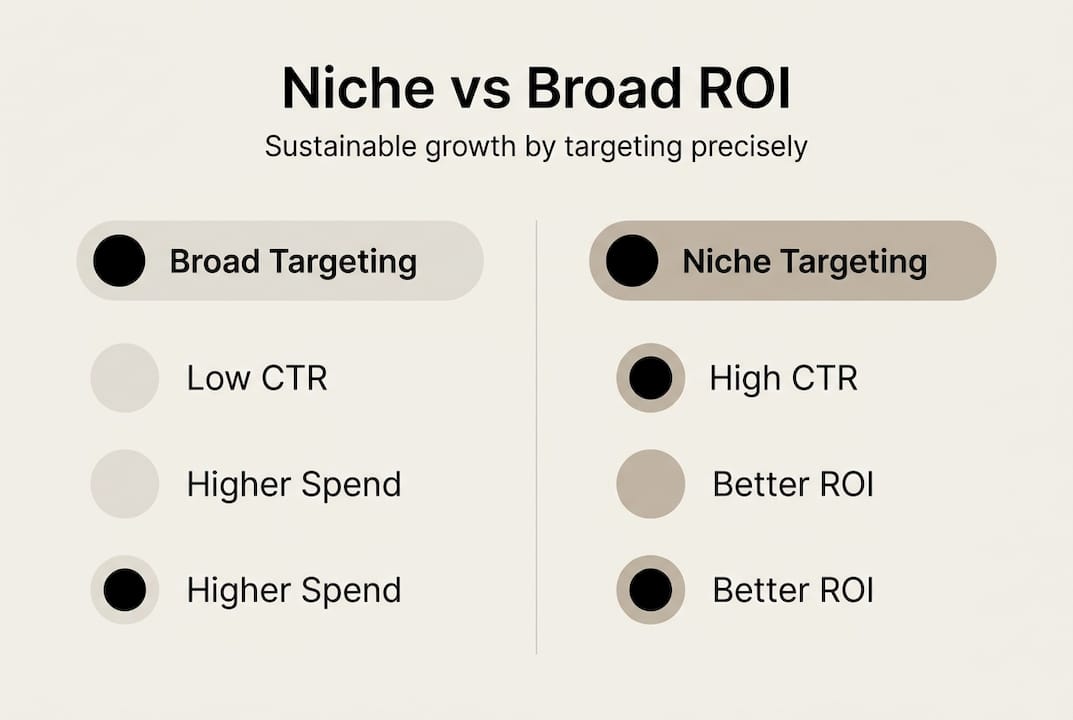
SMB marketing benchmarks for 2026 confirm that niche precision yields a median Google Search click-through rate of 3.2% and a ROAS of 2.5 to 3.8x for small budgets. That is more than double the return compared to broad approaches.
Here is a step-by-step process to optimise your niche campaigns for better ROI:
- Define your audience segment with precision. Age, location, intent, and pain points all matter.
- Audit your current campaigns to identify where spend is going to unqualified audiences.
- Refine your ad copy and creative to speak directly to your niche’s specific language and concerns.
- Test nano and micro-influencers in your sector. Nano and micro-influencers outperform macro-influencers for authenticity in niche markets.
- Track conversion metrics, not just reach. ROAS, cost per lead, and customer lifetime value are your real benchmarks.
- Iterate based on data, not assumptions. Niche campaigns improve significantly with each round of optimisation.
Paired with strong paid advertising for ROI and well-structured SEO strategies for targeting, niche campaigns can compound over time in ways that broad campaigns simply cannot.
Pro Tip: Do not confuse niche with small. A niche audience can be tens of thousands of highly qualified buyers. Niche means precision, not limitation. The goal is relevance, and relevance scales.
Community building and personalisation: The secret sauce of niche success
Conversion gets you a customer. Community keeps them. The brands that sustain niche growth over the long term are the ones that build genuine connections with their audience, not just transactional relationships.
RYZE Mushroom Coffee is a perfect example. Its community-driven growth was not accidental. The brand invested in creating spaces where customers could share experiences, ask questions, and feel part of something. That community became a self-sustaining acquisition engine, with existing customers bringing in new ones organically.
Personalisation plays an equally important role. When customers feel that a brand understands their specific situation, they are far more likely to return, spend more, and recommend the brand to others. In assisted living, this might mean tailored communications to families at different stages of the decision process. In luxury experiences, it might mean remembering a guest’s preferences from a previous visit.
Here are actionable ways to build and personalise your niche community:
- Create content that speaks to specific pain points, not general topics. Niche audiences can tell the difference immediately.
- Build email sequences that segment by behaviour, not just demographics.
- Use social proof from within the niche, such as testimonials from people who look and sound like your ideal customer.
- Host events or online spaces where your community can connect with each other, not just with your brand.
- Personalise follow-up communications based on where each customer is in their journey.
- Reward loyalty with exclusive access, early releases, or personalised offers that feel genuinely special.
For businesses at an earlier stage, startup community building provides a strong foundation for understanding how to grow an engaged audience from scratch.
Pro Tip: Start with micro-segments rather than trying to personalise for everyone at once. Pick your most loyal 20% of customers, understand what they have in common, and build your community strategy around them first. Expand from there as loyalty grows.
How to implement niche strategies: Actionable steps for your sector
Knowing the theory is one thing. Putting it into practice is where most businesses stall. Here is a practical framework, broken down by sector, to help you move from insight to action.
For assisted living providers:
- Map your catchment area and identify the specific postcodes and demographics most likely to enquire.
- Build landing pages that speak directly to the concerns of adult children making care decisions for a parent.
- Use Google Search campaigns with high-intent keywords like “care home near me” or “assisted living [town name]”.
- Collect and display testimonials from families who have been through the process.
- Implement an AI-powered follow-up system to nurture enquiries that do not convert immediately.
For e-commerce brands:
- Identify the single most specific problem your product solves and build all messaging around that.
- Find the online communities where your ideal customer already spends time.
- Partner with micro-influencers who have genuine credibility within that community.
- Build a post-purchase email sequence that deepens the relationship and encourages repeat buying.
- Use retargeting campaigns to re-engage visitors who showed high intent but did not purchase.
For luxury and experience brands:
- Define your ideal client profile in detail, including values, lifestyle, and what they consider worth paying a premium for.
- Audit your website and brand presentation to ensure they reflect the quality of your offering.
- Identify two or three micro-influencers whose audience matches your ideal client profile.
- Personalise every touchpoint, from initial enquiry to post-experience follow-up.
- Create exclusive content or experiences that reinforce the premium nature of your brand.
The underlying framework across all three sectors follows the same logic: identify, refine, engage, and scale. Niche marketing done well reduces waste and builds loyalty at every stage. Pair this with strong conversion optimisation on your website and you create a system where traffic, trust, and revenue compound together.
Pro Tip: Reassess your market fit every quarter. Niches evolve, and what resonated six months ago may need refining. Regular audience research keeps your targeting sharp and your messaging relevant.
Connect your niche vision to digital success
Understanding niche marketing is the first step. Building the systems to execute it consistently is where the real growth happens.

At NU Life Digital, we specialise in turning niche strategy into measurable results for assisted living providers, e-commerce brands, and luxury experience businesses. From expert web design that converts niche traffic into enquiries, to e-commerce solutions built for sustainable scaling, to AI automation that handles lead nurturing without adding to your workload, we build the full ecosystem your growth requires. If you are ready to stop wasting budget on broad campaigns and start building something that compounds, we would love to show you what is possible.
Frequently asked questions
How does niche marketing differ from traditional marketing?
Niche marketing targets a specific segment for higher relevance, trust, and ROI, whereas traditional marketing aims for broad reach and typically delivers lower engagement and conversion rates. Nano-influencers outperform macro in niche campaigns precisely because of this authenticity advantage.
What ROI can small businesses expect from niche strategies?
Small businesses using niche marketing see a median Google Search CTR of 3.2% and a ROAS of 2.5 to 3.8x, significantly outperforming broad targeting benchmarks.
Why are micro-influencers more effective in niche campaigns?
Micro-influencers have smaller but highly engaged audiences who trust their recommendations, delivering superior ROI in niche markets compared to macro-influencers with larger but less engaged followings.
How can assisted living providers use niche strategies?
Assisted living providers succeed by targeting locally with high-intent search campaigns and personalising communications to families at each stage of the decision process, which builds trust and drives consistent enquiries. Niche strategies reduce waste and build loyalty across the sector.
What is the first step to adopt niche marketing?
Begin with detailed market segmentation to identify your most valuable audience segment, then build all messaging and campaigns around their specific needs and behaviours. Sustainable niche growth starts with knowing exactly who you are talking to.