
TL;DR:
- Content must be focused on specific conversion actions, not just volume or visibility.
- Building trust, removing doubt, and clarifying next steps are key to driving conversions.
- Small, targeted content improvements can significantly increase conversion rates across sectors.
Most businesses publish content regularly, yet less than 40% see clear ROI from it. That gap is not a content volume problem. It is a conversion focus problem. For assisted living facilities trying to fill beds and e-commerce brands pushing for consistent monthly revenue, the difference between content that sits quietly on a page and content that actively drives enquiries or purchases is enormous. This guide cuts through the confusion. You will learn exactly what conversion means in your sector, why certain content triggers action while other content does not, and how to apply practical, tested strategies that move visitors from passive readers to paying customers or booked tour guests.
Table of Contents
- Defining conversion: more than just sales
- How content drives user action
- Optimising content for higher conversions
- Real-world examples: content success in assisted living and e-commerce
- Why most content fails and what actually works
- Take your conversions further with expert support
- Frequently asked questions
Key Takeaways
| Point | Details |
|---|---|
| Conversion defined broadly | Conversion includes not just sales but every meaningful user action guided by your content. |
| Content shapes decisions | Strategic content builds trust, addresses objections, and motivates users to act. |
| Optimisation is ongoing | Continuous refinement and testing of content are crucial for sustained conversion gains. |
| Learn from real examples | Adopting proven strategies from assisted living and e-commerce can accelerate your own success. |
| Quality over quantity | Focusing on targeted, high-value content delivers greater conversion impact than sheer volume. |
Defining conversion: more than just sales
Before you can optimise anything, you need to be clear on what you are actually trying to achieve. Many business owners treat conversion as a single event, usually a sale. But that framing causes them to miss dozens of smaller, high-value actions that directly feed revenue growth.
Conversion for business growth covers a wide spectrum. As the principle goes, conversion can mean many things, from new leads to appointments booked or products purchased. In practice, this means your content needs to be engineered around the specific actions that matter most to your business model.
In assisted living, the conversion journey looks very different from e-commerce. Families researching care options rarely make a decision in one visit. They read, compare, and return multiple times before picking up the phone. Your content needs to serve them at every stage of that process.
Here is a comparison of hard and soft conversions across both sectors:
| Conversion type | Assisted living examples | E-commerce examples |
|---|---|---|
| Hard conversions | Tour booking, admissions enquiry | Product purchase, subscription sign-up |
| Soft conversions | Brochure download, callback request | Wishlist addition, newsletter sign-up |
| Micro conversions | Page scroll depth, video view | Add to cart, product page visit |
Soft conversions matter because they signal intent. A family that downloads your care guide is not ready to book a tour today, but they are far closer than someone who just landed on your homepage. Content that captures soft conversions keeps prospects inside your ecosystem until they are ready to act.
Key conversion goals to map your content around:
- Enquiry form submissions
- Live chat initiations
- Resource or brochure downloads
- Email newsletter sign-ups
- Product purchases and repeat orders
- Tour or consultation bookings
“The businesses that grow fastest are the ones that treat every interaction as a conversion opportunity, not just the final purchase.”
Understanding what conversion means in its full breadth changes how you write, structure, and publish content entirely.
How content drives user action
With conversion clearly defined, let us break down how content influences the user’s decisions at each touchpoint.
Content does three things that directly drive action. It builds trust, removes doubt, and makes the next step obvious. When any one of these is missing, visitors leave without converting. It sounds simple, but most websites fail on at least two of the three.
The psychology behind content-driven action is well established. Visitors make decisions based on a combination of emotional and rational triggers. Your content needs to speak to both. Well-structured content can increase website conversions by up to 113%, which tells you the structural and psychological design of your content is just as important as the words themselves.
The psychological triggers that convert readers into customers:
- Authority: Credentials, case studies, and expert commentary establish you as the trusted choice
- Social proof: Testimonials, reviews, and occupancy figures reassure hesitant prospects
- Urgency: Limited availability or time-sensitive offers prompt faster decisions
- Clarity: Plain, specific language removes confusion and reduces friction
- Empathy: Acknowledging the reader’s fears or challenges builds an immediate emotional connection
For assisted living, empathy and authority are the dominant drivers. Families are making one of the most emotionally charged decisions of their lives. Content that acknowledges that weight, then provides clear, reassuring information, converts far better than content that simply lists facilities and pricing.

For e-commerce, social proof and urgency tend to do the heaviest lifting. Product pages with verified reviews, real customer photos, and stock scarcity signals consistently outperform those without. Content’s role in digital healthcare further reinforces how trust-building content shapes decisions in high-stakes environments.
Pro Tip: The single most overlooked improvement in optimising content for conversion is the clarity of your primary call-to-action. Most pages bury it or use vague language like “learn more.” Replace it with a specific, benefit-led instruction such as “Book your free tour today” or “Get your personalised quote” and test the difference. You can also build stronger conversion workflow strategies around these trigger points to guide users through a structured journey.
Optimising content for higher conversions
Understanding the factors at play, here is how you can turn those insights into practical steps for improving your own content.
Small changes in headline and call-to-action phrasing have shown substantial conversion uplifts, which means even a focused afternoon of edits can produce measurable results. You do not need to rebuild everything from scratch.
Follow these steps to systematically improve your content:
- Rewrite your headline to lead with a specific benefit or outcome, not a feature or generic welcome message
- Structure your page so the most important information appears above the fold, before users need to scroll
- Add visual aids such as photos, short videos, or infographics to break up text and reinforce key messages
- Refine your CTA to be specific, visible, and repeated at logical intervals throughout the page
- Use internal linking to guide readers toward related content or service pages that support the conversion path
- Test and iterate by running A/B tests on headlines, CTA copy, and page layout to identify what works for your specific audience
Here is a snapshot of the kind of uplift small content changes can produce:
| Content element | Before change | After change | Conversion uplift |
|---|---|---|---|
| Headline | “Welcome to our care home” | “Trusted senior care in [City] with 98% family satisfaction” | +42% |
| CTA button | “Submit” | “Book your free tour today” | +37% |
| Product description | Feature list only | Benefits-led copy with social proof | +29% |
| Page structure | Long paragraphs, no headers | Scannable format with clear sections | +31% |
The data from marketing statistics consistently shows that format and readability affect conversion as much as the message itself. Visitors scan before they read. If your page does not pass the five-second scan test, most users will not stay long enough to be converted.
Building SEO-driven content alongside conversion optimisation creates a compounding effect. You attract more qualified traffic and convert a higher percentage of it. That combination is where real growth happens. Strong building brand trust principles also reinforce every content decision you make.
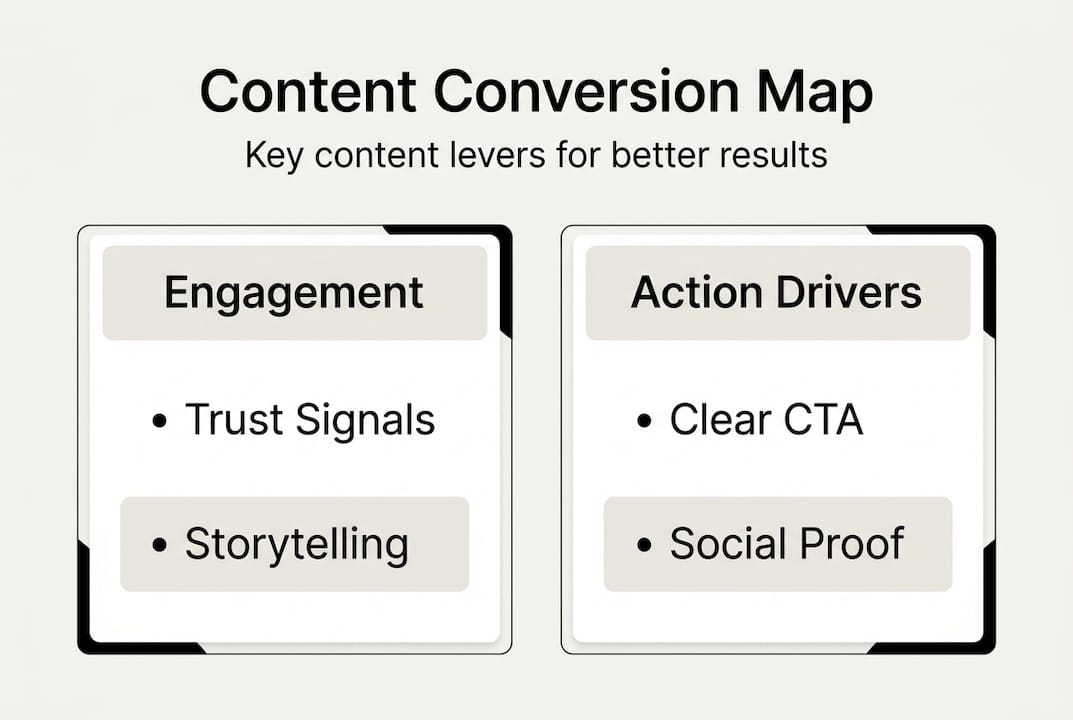
Pro Tip: Avoid the common pitfall of optimising for traffic alone. A page ranking on page one of Google but converting at under 1% is a missed opportunity. Always pair your SEO goals with a clear conversion objective for every piece of content you publish.
Real-world examples: content success in assisted living and e-commerce
Let us bring these strategies to life with real examples from both assisted living and e-commerce.
Strategy without evidence is just theory. Here is what conversion-focused content actually looks like in practice across both sectors.
- Assisted living facility, UK: A care provider rewrote their homepage and key service pages to lead with family-centred language, added resident testimonials with photos, and introduced a downloadable care guide as a soft conversion tool. Enquiry form submissions increased by over 50% within 90 days.
- E-commerce brand, fashion sector: A mid-sized clothing retailer restructured their product pages to include size guides, customer photos, and a clear returns policy above the fold. Cart abandonment dropped by 22% and average order value rose as customers felt more confident in their purchases.
- Assisted living group, US: By implementing updated content frameworks and redesigning their assisted living conversion pathways, the group achieved a measurable uplift in qualified enquiries within a single quarter.
“Updated content frameworks led to a 35% increase in lead generation for assisted living businesses.”
What makes these examples instructive is not just the results. It is the shared approach behind them. Each business stopped asking “what do we want to say?” and started asking “what does our visitor need to hear to take the next step?” That shift in perspective is what separates content that converts from content that simply exists.
The strategies transfer well between sectors too. Social proof, clarity, and empathetic framing work whether you are selling a product or asking a family to trust you with a loved one’s care. Staying across digital marketing trends in 2026 ensures your content approach keeps pace with how audiences are consuming and acting on information.
Why most content fails and what actually works
Reflecting on these examples, here is a perspective you will rarely hear from the usual guides.
The most common content mistake we see is not poor writing. It is misaligned intent. Businesses produce content to fill a calendar, satisfy an SEO checklist, or demonstrate activity. None of those motivations produce content that converts.
Conversion-focused content is built around a single question: what does this specific visitor need to believe, feel, or understand before they will act? Every heading, sentence, and image should serve that question. When it does not, the content is noise, regardless of how well it ranks.
The brands that consistently outperform their competitors on conversion are not publishing more. They are publishing with precision. One well-structured page that addresses a genuine concern, builds trust, and makes the next step obvious will outperform ten generic blog posts every single time.
Our digital agency insights consistently show that the businesses who invest in fewer, better content assets and then optimise them relentlessly see far greater returns than those chasing volume. Quality with intent beats quantity every time.
Take your conversions further with expert support
If you are ready to move beyond theory and turn content into real business growth, here is your next step.
At NU Life Digital, we build content and web systems that are engineered to convert, not just to look good or rank. Whether you need web design services that guide visitors toward action, e-commerce growth solutions that turn traffic into consistent revenue, or a focused audit of your existing conversion optimisation tips, we have the expertise to deliver measurable results.
We work with assisted living facilities and e-commerce brands that are serious about growth. If your content is not converting at the level your business needs, let us change that. Get in touch with our team today and we will show you exactly where the opportunity lies.
Frequently asked questions
What types of content influence conversion rates the most?
Clear landing pages, strong calls-to-action, and educational blog posts typically have the highest impact, as certain content formats have proven, measurable effects on conversion rates.
How can I measure the value of content in driving conversions?
Track conversion events using analytics tools and compare user behaviour before and after content changes. Tracking conversion events is essential for understanding which content is genuinely driving ROI.
Is content as crucial for assisted living websites as it is for e-commerce?
Yes. Strategic, trust-building content is essential in both sectors. Content plays a key role in guiding decision-makers through the enquiry process in assisted living, just as it does in driving purchases in e-commerce.
What is the quickest content improvement for better conversions?
Refining your CTA wording and making it highly visible is the fastest win. Small tweaks to CTA copy and placement can produce significant conversion uplifts with minimal effort.
Recommended
- Website conversion: the key to business growth in 2026 – Nu Life Digital
- Website conversion workflow that drives measurable growth – Nu Life Digital
- Boost revenue with top website conversion optimisation tips – Nu Life Digital
- 2026’s top digital marketing trends for strategic growth – Nu Life Digital