
Care home operators across the US and UK are facing a sharper battle for occupancy than ever before. Traditional referral networks, once the backbone of admissions, are no longer enough on their own. Families are searching online before they ever pick up the phone, and if your care home is not visible in those searches, you are losing enquiries to competitors who are. This guide walks you through the practical steps to build a digital marketing approach that fills more beds, streamlines your admissions process, and positions your home as the obvious choice in your local area.
Table of Contents
- Understanding the digital marketing opportunity
- Setting solid digital foundations for your care home
- Developing a winning digital marketing strategy
- Key digital marketing tactics that fill more beds
- Avoiding common mistakes in care home marketing
- Measuring results and refining your approach
- Take the next step: expert help with care home digital marketing
- Frequently asked questions
Key Takeaways
| Point | Details |
|---|---|
| Strong digital presence | A modern, well-designed website and local listings are essential for attracting enquiries. |
| Strategy-driven marketing | A planned mix of SEO, content, and paid ads brings the best results for care home occupancy. |
| Monitor and evolve | Regularly track results to refine your approach and maximise admissions impact. |
| Avoid common pitfalls | Update your online presence and respond to feedback to maintain trust and fill beds. |
Understanding the digital marketing opportunity
The way families choose care homes has changed fundamentally. A decade ago, word of mouth and GP referrals dominated. Today, online searches are the primary method families use when researching care options for a loved one. That shift is not slowing down.
Digital marketing gives care homes something traditional methods never could: measurable, scalable reach. Here is what that means in practice:
- Broader reach: Your home becomes visible to families searching across your entire region, not just those who happen to know someone who knows you.
- Higher enquiry volume: A well-optimised online presence generates consistent inbound enquiries rather than relying on sporadic referrals.
- Measurable results: Every click, form submission, and phone call can be tracked, so you know exactly what is working.
- Integrated admissions: Digital marketing does not sit apart from your admissions process. It feeds directly into it, bringing pre-qualified families to your door.
Statistic: Care homes that invest in care home SEO strategies consistently report higher enquiry volumes compared to those relying solely on offline referrals.
The opportunity is real. The question is whether you are set up to capture it.
Setting solid digital foundations for your care home
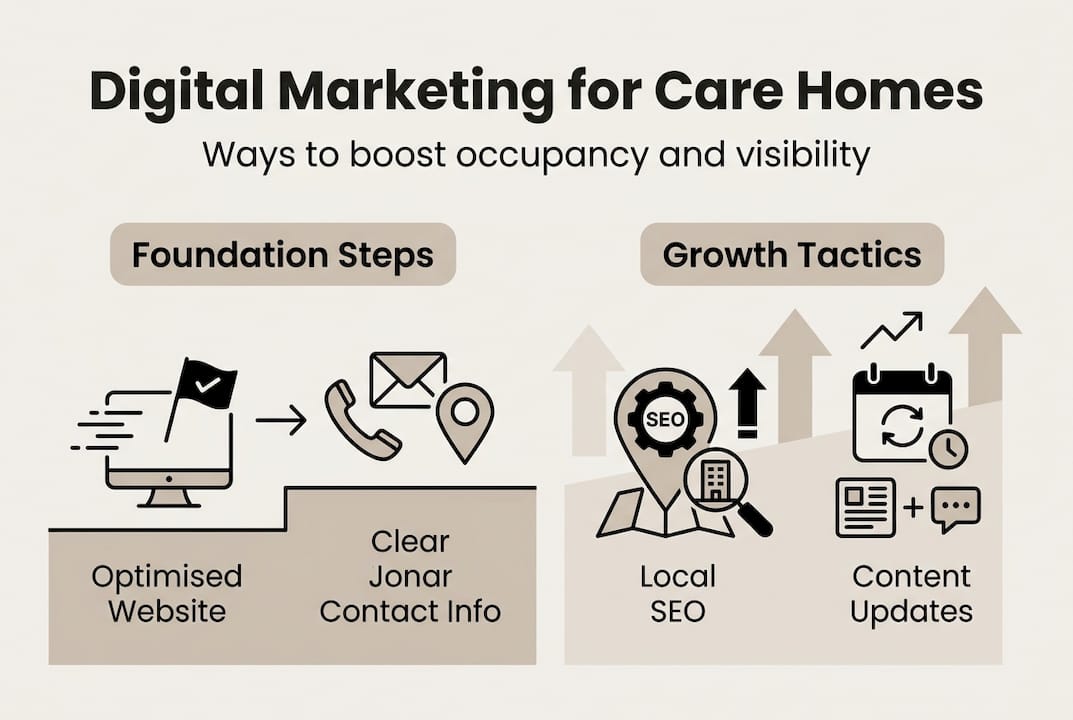
Before you spend a penny on advertising, your digital foundations need to be solid. Think of it like preparing a room before a family visits. First impressions matter enormously.
A professional, responsive website is non-negotiable. Families researching care homes are often under emotional stress, and a slow or confusing website will send them straight to a competitor. Web design for conversions is not about aesthetics alone. It is about guiding a worried family member from their first visit to booking a tour, with as little friction as possible.
Here is a quick checklist of digital essentials every care home needs:
- A mobile-friendly website that loads in under three seconds
- A verified and fully completed Google Business Profile
- Accurate listings on key directories such as carehome.co.uk and Caring.com
- Up-to-date contact details, opening hours, and a clear enquiry form
- A photo gallery showing real rooms, communal spaces, and staff
- A privacy policy that meets GDPR or HIPAA requirements depending on your location
| Foundation element | Why it matters |
|---|---|
| Mobile-optimised website | Over 60% of care searches happen on mobile devices |
| Google Business Profile | Drives local map pack visibility and direct calls |
| Online directory listings | Builds trust and improves local search rankings |
| Photo gallery | Increases time on site and enquiry conversion rates |
| Privacy compliance | Protects your home legally and builds family trust |
Pro Tip: Ask a friend or family member who is unfamiliar with your home to navigate your website and try to make an enquiry. Their experience will reveal friction points you have become blind to.
Once your digital marketing workflow is built on these foundations, every campaign you run will perform significantly better.
Developing a winning digital marketing strategy
A strategy without clear goals is just activity. Before you launch any campaign, define what success looks like for your home. Is it ten new enquiries per month? A specific occupancy percentage? A faster admissions timeline?
Here is a simple three-step process to build your plan:
- Set specific goals. Tie your marketing objectives directly to occupancy targets. For example, if you need to fill four beds in the next quarter, work backwards to understand how many enquiries and tours that requires.
- Allocate your budget across channels. Organic channels like SEO for care homes take time to build but deliver compounding returns. Paid channels like Google Ads deliver faster results but require ongoing spend. A balanced approach works best.
- Track and adjust. Set up analytics from day one. Digital marketing plan performance should be reviewed monthly, with budget and messaging adjusted based on what the data tells you.
| Channel | Time to results | Cost level | Best for |
|---|---|---|---|
| Local SEO | 3 to 6 months | Low to medium | Sustained inbound enquiries |
| Google Ads (PPC) | 1 to 4 weeks | Medium to high | Fast occupancy boosts |
| Social media | 1 to 3 months | Low to medium | Brand awareness and trust |
| Email marketing | Immediate | Very low | Nurturing warm leads |
Pro Tip: Do not try to be everywhere at once. Pick two or three channels, execute them well, and expand once you have proof of what works for your specific home and location.
Key digital marketing tactics that fill more beds
With your strategy in place, these are the tactics that consistently drive admissions for care homes.
Local search optimisation is your single biggest lever. When a family types “care home near me” or “dementia care in your town],” you need to appear in the top results. [Optimising care home SEO means targeting location-specific keywords, earning local backlinks, and keeping your Google Business Profile active with regular posts and photo updates.
Lead-generating content converts browsers into enquirers. FAQs about fees and care types, genuine testimonials from families, and virtual tours of your facilities all reduce the anxiety families feel and move them closer to making contact. This type of content also improves your search rankings organically.
Targeted paid advertising lets you reach specific demographics. A Facebook campaign targeting adults aged 45 to 65 within a 15-mile radius of your home, for example, puts your message in front of the exact people making care decisions for ageing parents.
Reputation management is often overlooked but critical. Responding to every review, positive or negative, signals to families that your home is attentive and trustworthy. Conversion optimisation tips consistently show that homes with strong review profiles convert significantly more website visitors into enquiries.
“Families making care decisions are not just looking for a bed. They are looking for reassurance. Every piece of content, every review response, and every page of your website is either building or eroding that trust.”
Pro Tip: Set up a Google Alert for your care home’s name so you are notified immediately when a new review or mention appears online. Speed of response matters.
Avoiding common mistakes in care home marketing
Even well-intentioned marketing efforts can backfire if you fall into these common traps.
- Leaving outdated information online. Incorrect phone numbers, old photos, or closed services listed on your website or directories actively harm trust. Building brand trust online starts with accuracy. Audit every listing and page at least quarterly.
- Ignoring mobile users. If your website is not optimised for smartphones, you are invisible to the majority of families searching for care. A poor mobile experience is one of the fastest ways to lose an enquiry before it even begins.
- Spreading budget too thin. Trying to run Google Ads, Facebook campaigns, SEO, and email marketing simultaneously with a limited budget means none of them get enough resource to perform. Focus and depth beat breadth every time.
Pro Tip: Run a free mobile usability test using Google’s PageSpeed Insights tool. It will show you exactly how your site performs on mobile and flag specific issues to fix.
Measuring results and refining your approach
Marketing without measurement is guesswork. Setting up proper tracking from the start means you can see which channels are driving real admissions, not just traffic.
Here is what to track as a minimum:
- Enquiry form submissions tracked via Google Analytics goals or a CRM system
- Phone calls using call tracking software that attributes calls to specific campaigns
- Tour bookings recorded and linked back to the marketing source
- Enquiry-to-admission conversion rate to understand where families drop out of the process
- Cost per enquiry for each paid channel to assess return on investment
Tracking web enquiries and linking them to actual admissions is the only way to know whether your marketing spend is genuinely filling beds.
| Metric | What it tells you | Review frequency |
|---|---|---|
| Enquiry volume | Whether your visibility is growing | Weekly |
| Enquiry source | Which channels are performing | Monthly |
| Cost per enquiry | Whether paid spend is efficient | Monthly |
| Admission conversion rate | Where families drop out | Quarterly |
Use website conversion analytics to identify pages where visitors leave without taking action. Often, small changes to a headline or a contact form can produce a meaningful lift in enquiries without any additional ad spend.
Take the next step: expert help with care home digital marketing
Putting all of this into practice takes time, expertise, and the right systems. At NU Life Digital, we specialise in helping care homes and assisted living facilities build the digital infrastructure that drives consistent occupancy growth.

Our web design services are built specifically to convert anxious families into confident enquirers. Our team of digital marketing specialists creates strategies grounded in your occupancy goals, not vanity metrics. And our conversion optimisation experts ensure every visitor your marketing brings in has the best possible chance of becoming an admission. If you are ready to move from reactive to proactive, we would love to show you what a properly built growth system looks like for your home.
Frequently asked questions
How can digital marketing increase care home occupancy?
Digital marketing drives sustained inbound enquiries by making your home visible to families actively searching for care, which directly increases the number of admissions opportunities you receive each month.
What digital channels are best for care homes?
Local SEO, a fully optimised Google Business Profile, and targeted web content consistently deliver the strongest results, with paid Google Ads providing a useful boost when you need to fill beds quickly.
What are the common digital marketing mistakes for care homes?
Not updating website information, failing to respond to reviews, and neglecting mobile optimisation are the three most damaging errors, all of which harm trust and reduce enquiry conversion rates.
How soon will I see results from digital marketing for my care home?
Paid advertising can generate enquiries within a few weeks when managed correctly, while SEO and content marketing typically build momentum over three to six months and deliver more sustainable long-term results.