
TL;DR:
- Genuine omnichannel connects all touchpoints into a seamless, unified customer experience.
- Benefits include higher retention, better attribution, increased lifetime value, and brand consistency.
- Success requires organizational alignment, phased implementation, and continuous review of strategies.
Most marketing teams believe they are doing omnichannel. Few actually are. The gap between running campaigns across multiple platforms and genuinely integrating those channels into one seamless customer experience is enormous, and it is costing businesses real revenue. Attribution inconsistency affects nearly half of omnichannel teams, leading to less than 50% accuracy in tracking marketing success. This article breaks down exactly what omnichannel marketing involves, why it matters for scalable growth, the real challenges you will face, and the practical steps to build a strategy that actually works.
Table of Contents
- Defining omnichannel marketing: More than just multiple channels
- Core benefits of omnichannel marketing for growing businesses
- Common challenges in omnichannel marketing (and how to overcome them)
- Key steps to start building your omnichannel strategy
- Why most brands miss the mark: A hard-won lesson on omnichannel success
- Ready to take omnichannel from theory to growth?
- Frequently asked questions
Key Takeaways
| Point | Details |
|---|---|
| Omnichannel vs multichannel | Omnichannel focuses on integration and clear customer journeys, while multichannel simply expands contact points without unification. |
| Business growth advantages | Omnichannel marketing leads to higher retention, better ROI, and stronger brand consistency. |
| Overcoming challenges | Phased rollout, AI adoption, and cross-training are essential to resolving data silos and setup costs. |
| Actionable first steps | Evaluate key customer channels, prioritise integration, and commit to ongoing strategy refinement. |
Defining omnichannel marketing: More than just multiple channels
Omnichannel marketing is not simply using several platforms at once. It is the practice of connecting every channel, touchpoint, and customer interaction into one unified, consistent experience. Whether a customer first discovers your brand through a paid social ad, visits your website, abandons a cart, and then walks into your physical store, the experience should feel like one continuous conversation rather than a series of disconnected encounters.
This is where most businesses get it wrong. Multichannel marketing means you are present on multiple platforms. Omnichannel marketing means those platforms share data, messaging, and context. The customer is always at the centre, and every channel responds to what they have already done elsewhere.
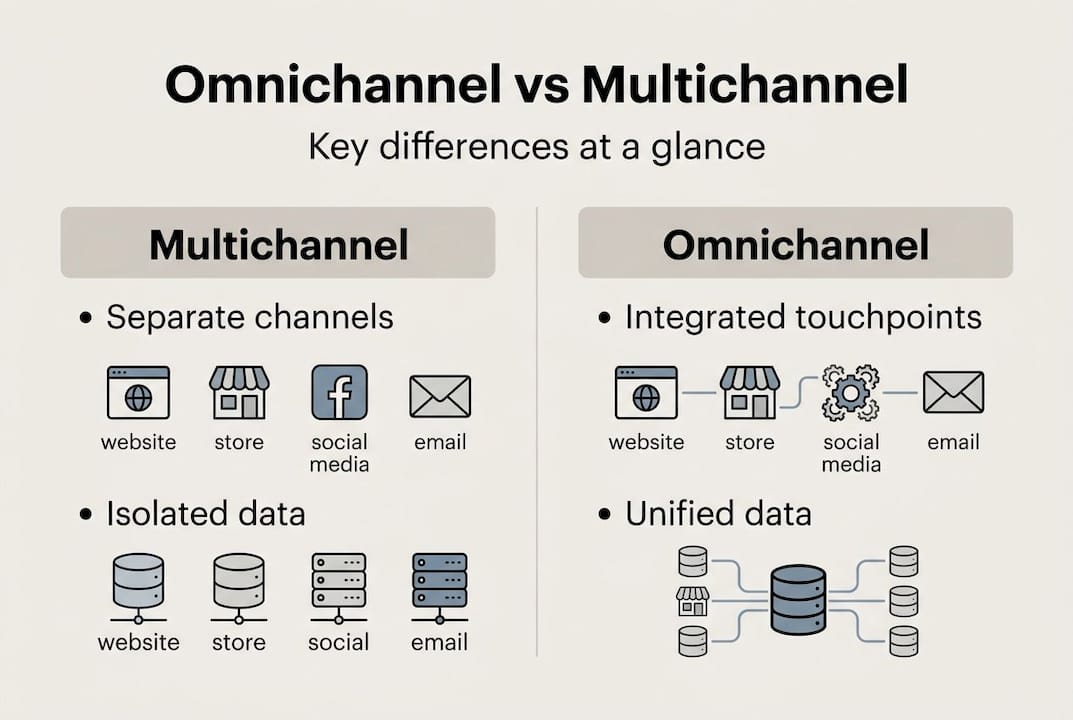
Here is a clear comparison:
| Feature | Multichannel | Omnichannel |
|---|---|---|
| Channel focus | Each channel operates independently | All channels are integrated |
| Customer view | Fragmented across touchpoints | Unified single customer view |
| Messaging | May vary per channel | Consistent and contextual |
| Data sharing | Siloed by platform | Shared across all systems |
| Goal | Reach | Seamless experience |
A practical example: a customer browses trainers on your app, then receives an email the next morning featuring exactly those trainers with a discount code. They click through, purchase on desktop, and receive an SMS confirmation. That is omnichannel. Each channel knew what the last one did.
The confusion between these two approaches is more widespread than many realise. True omnichannel marketing overcomes silos that persist in 41% of implementations, meaning nearly half of businesses claiming to do omnichannel are still operating in fragmented ways. Understanding this distinction is the foundation of everything else. For broader context on where digital marketing is heading, the 2026 digital marketing trends landscape makes clear that integration and personalisation are no longer optional.
Key characteristics of a genuine omnichannel approach include:
- A single, shared customer data profile across all platforms
- Consistent brand voice and visual identity everywhere
- Real-time data syncing between channels
- Personalised messaging based on cross-channel behaviour
- Seamless handoffs between online and offline touchpoints
Core benefits of omnichannel marketing for growing businesses
Now that the term is defined, consider why omnichannel marketing should take priority in your growth strategy. The benefits are not theoretical. They show up directly in revenue, retention, and efficiency.
Higher customer retention is the most cited advantage. Customers who experience a consistent, personalised journey across channels are significantly more likely to return. They feel recognised rather than marketed at, and that distinction builds genuine loyalty over time.

Improved attribution and ROI follow naturally from integration. When your channels share data, you can actually see which combination of touchpoints drives a conversion. This removes guesswork from your budget decisions and lets you invest where it genuinely performs.
Increased customer lifetime value is another direct outcome. A customer who engages with your brand across email, social, and your website spends more over time than one who only interacts through a single channel. Cross-channel engagement deepens the relationship.
Stronger brand consistency builds trust at scale. Every interaction reinforces the same message, tone, and promise. This is particularly important for e-commerce brands competing on experience as much as product.
A phased rollout and AI adoption significantly improve the effectiveness of omnichannel efforts, particularly for teams that are just beginning to integrate their channels. This is where AI-driven analytics become genuinely powerful, enabling you to spot patterns across channels that no human analyst could track manually. Pairing that with a strong customer-focused strategy ensures the technology serves real business goals rather than becoming an expensive distraction.
Pro Tip: Do not attempt to personalise every channel simultaneously from the start. Begin with your highest-traffic touchpoint, get the data flowing correctly, and then expand. Trying to do everything at once is how personalisation projects stall before they deliver results.
The compounding effect of these benefits is what makes omnichannel marketing so powerful for scaling businesses. Each improvement reinforces the others, creating a growth loop rather than isolated wins.
Common challenges in omnichannel marketing (and how to overcome them)
Despite the obvious benefits, many businesses face notable barriers when attempting to implement omnichannel strategies. Understanding these obstacles in advance is the difference between a successful rollout and an expensive lesson.
Unresolved edge journeys hinder 36% of marketers, and data silos persist in 41% of implementations. These are not minor technical issues. They represent fundamental gaps in how teams, tools, and data are structured.
Here are the most common challenges and practical solutions:
| Challenge | Practical solution |
|---|---|
| Data silos between platforms | Implement a centralised CRM or customer data platform |
| High set-up costs | Use a phased rollout to spread investment over time |
| Attribution inconsistency | Adopt multi-touch attribution modelling with AI support |
| Team silos and misalignment | Cross-train marketing, sales, and service teams |
| Unresolved edge-case journeys | Map all customer paths, including non-linear ones |
To work through these challenges systematically, follow this order:
- Audit your current channels. Identify where data is being collected, where it is being lost, and where handoffs between channels are breaking down.
- Consolidate your data infrastructure. Choose a single source of truth for customer data before adding more channels.
- Align your teams. Marketing, sales, and customer service must share goals, not just tools. Siloed teams produce siloed experiences.
- Introduce AI technologies gradually. Use automation to bridge gaps in data and communication rather than attempting a full overhaul at once.
- Review and iterate regularly. Omnichannel is not a one-time project. Build in quarterly reviews to catch new gaps as your customer base evolves.
Pro Tip: Edge-case journeys are the ones that break your strategy. Map out what happens when a customer contacts support mid-purchase, returns a product bought online in-store, or switches devices mid-session. These scenarios reveal where your integration is genuinely weak.
For teams that need outside expertise, AI integration for marketing can accelerate the process significantly. And if the complexity feels overwhelming, digital agency support can provide the strategic and technical foundations you need without the overhead of building everything in-house.
Key steps to start building your omnichannel strategy
To move beyond barriers, set your strategy with these foundational actions. The good news is that you do not need to have everything in place before you start seeing results.
A phased rollout helps overcome upfront complexity and cost challenges, making it the most practical starting point for most growing businesses. Here is a clear five-step process:
- Map your customer journey. Identify every touchpoint where a customer interacts with your brand, from first awareness through to post-purchase. Note where data is collected and where it disappears.
- Prioritise your top two or three channels. Focus on the platforms where your customers are most active and where integration will deliver the fastest return. Do not spread effort across every channel at once.
- Unify your data. Connect your key platforms through a CRM or customer data platform. AI for data management can automate much of this process and reduce the manual burden on your team.
- Align messaging and brand voice. Ensure that every channel reflects the same tone, visual identity, and core message. Inconsistency at this level undermines the entire strategy.
- Measure, review, and expand. Set clear KPIs for each channel and review them regularly. Use the data to identify which integrations are performing and where gaps remain. ROI-driven advertising works best when it feeds into a broader omnichannel picture rather than operating in isolation.
Quick wins to pursue early:
- Connect your email platform to your e-commerce store for abandoned cart sequences
- Sync your paid ad audiences with your CRM data for retargeting
- Ensure your social profiles and website share the same brand language
Common mistakes to avoid:
- Launching too many channels before your data infrastructure is ready
- Treating omnichannel as a technology project rather than a customer experience project
- Neglecting offline touchpoints if your business has a physical presence
Why most brands miss the mark: A hard-won lesson on omnichannel success
Here is what the roadmaps and case studies rarely tell you. Most omnichannel failures are not caused by choosing the wrong software. They are caused by underestimating the cultural and organisational change required to make integration work.
We have seen businesses invest heavily in platforms, connect their data, and still produce fragmented customer experiences. Why? Because the marketing team, the sales team, and the customer service team were still operating with separate priorities, separate metrics, and separate definitions of success.
Omnichannel is not a checklist you complete. It is a continuous process of alignment, iteration, and honest review. The brands that get it right are the ones that treat it as an ongoing discipline rather than a launch event. They cross-train their teams, they map edge-case journeys obsessively, and they are willing to slow down in order to build correctly.
Staying current with AI insights for marketers is part of that discipline. The tools evolve quickly, and the teams that adapt continuously outperform those that implement once and move on.
Ready to take omnichannel from theory to growth?
Understanding omnichannel is one thing. Building it in a way that actually drives revenue is another challenge entirely.

At NU Life Digital, we specialise in turning omnichannel strategy into measurable growth for e-commerce brands and service businesses. From AI integration and automation that connects your channels and eliminates data silos, to expert web design that converts visitors at every stage of the journey, and eCommerce solutions built to scale, we provide the full infrastructure your omnichannel strategy needs. Whether you are starting from scratch or fixing a fragmented setup, we are the growth partner that builds it properly.
Frequently asked questions
How does omnichannel marketing improve customer experience?
It ensures customers receive a seamless, consistent experience across all touchpoints, which builds trust and increases satisfaction. Omnichannel strategies drive stronger brand consistency, directly improving how customers feel about every interaction with your brand.
What is the main difference between omnichannel and multichannel marketing?
Omnichannel integrates all channels into one cohesive customer journey, while multichannel simply uses multiple platforms without guaranteeing they communicate with each other. Notably, 41% of omnichannel implementations still struggle with data silos, something multichannel rarely even attempts to address.
How can small teams get started with omnichannel marketing?
Begin with a phased rollout, focusing on your two or three most valuable channels before expanding. Phased rollout and technology adoption resolve the most common silo and set-up cost barriers that small teams face.
What challenges should marketers watch for when adopting omnichannel approaches?
Data and team silos, unresolved customer journeys, and inaccurate attribution are the primary obstacles to anticipate. Edge cases, team silos, and attribution inconsistency are the issues most likely to undermine an otherwise well-planned omnichannel strategy.