
Many businesses pour thousands into digital marketing only to watch budgets evaporate with little to show. Without a clear workflow connecting your efforts, you’re essentially guessing which channels drive real growth. This guide walks you through building a proven digital marketing strategy workflow tailored specifically for e-commerce and assisted living sectors in 2026. You’ll learn how to coordinate your channels, allocate budgets wisely, and create systems that consistently attract, convert, and retain customers.
Table of Contents
- Preparing Your Digital Marketing Strategy Workflow
- Building And Implementing Your Marketing Workflow
- Tailoring Workflows For Assisted Living Marketing
- Measuring Success And Troubleshooting Common Challenges
- Enhance Your Digital Marketing With NU Life Digital
- Frequently Asked Questions
Key takeaways
| Point | Details |
|---|---|
| Workflow structure | A digital marketing workflow balances attracting new visitors, converting them to customers, and retaining them for repeat business. |
| E-commerce focus | E-commerce workflows prioritise conversion optimisation, SEO, paid advertising, social media engagement, and email automation. |
| Assisted living nuances | Assisted living requires local SEO, dual audience messaging for seniors and adult children, and trust-building strategies. |
| Budget allocation | Typically 40% paid ads, 30% SEO and content, 15% social, 10% email, 5% tools, but varies by sector needs. |
| Success metrics | Track conversion rates, traffic quality, customer retention, and attribution accuracy to optimise your workflow continuously. |
Preparing your digital marketing strategy workflow
Before you build any workflow, you need solid foundations. Start by clarifying your business objectives. Are you aiming for 30% revenue growth? Reducing customer acquisition costs? Your marketing goals must align directly with these business targets. This clarity shapes every decision, from budget allocation to channel selection.
Next, identify your primary target audiences with precision. For e-commerce, you’re typically speaking directly to end consumers making purchase decisions. For assisted living, you’re navigating a more complex landscape where 73% of decisions involve adult children rather than the seniors themselves. This fundamental difference transforms your entire messaging strategy.
Understand the distinct sales cycles for each sector. E-commerce often operates on impulse or short consideration periods, sometimes measured in hours or days. Assisted living involves months of research, facility tours, and family discussions. These timelines dictate how you nurture leads and structure your retention efforts.
Establish your channel priorities based on where your audience actually spends time. Both sectors benefit from SEO and paid advertising, but the emphasis shifts. E-commerce thrives on conversion optimisation and email automation, whilst assisted living demands stronger local search presence and trust-building content. Assisted living marketing budgets typically allocate 10 to 20% of revenue, with heavy emphasis on channels that build credibility.
Pro Tip: Run small initial tests on email sequences and social content before scaling paid ad spend. These lower-cost channels reveal messaging that resonates, allowing you to invest confidently in expensive paid campaigns with proven copy and offers.
Building and implementing your marketing workflow
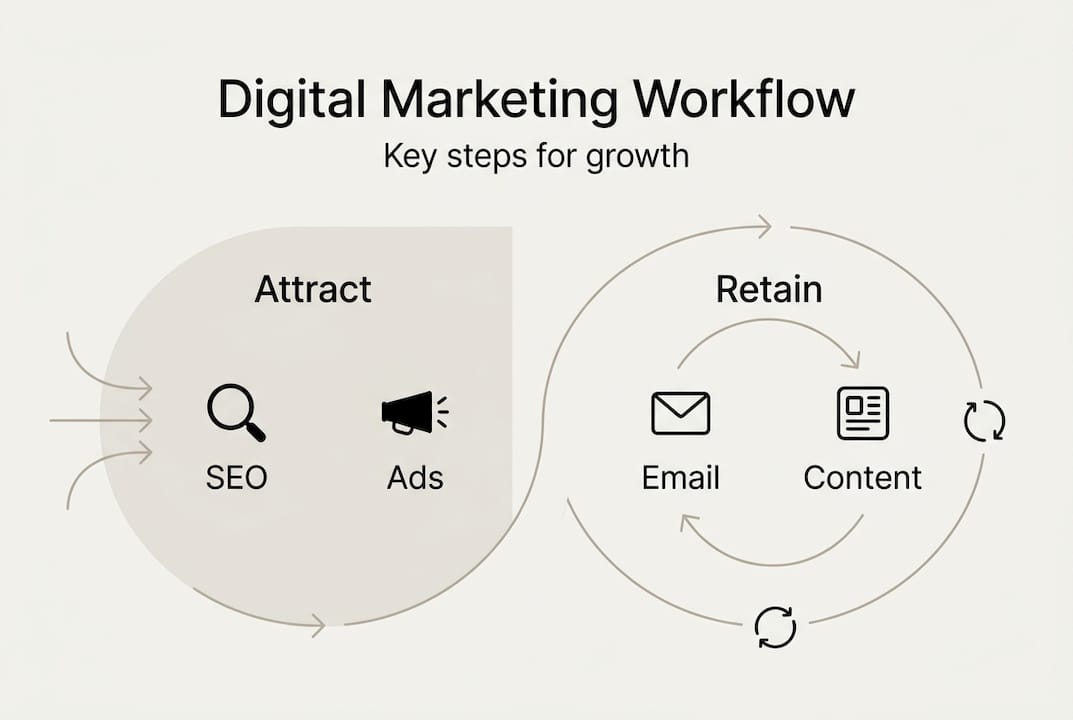
Your workflow should follow the attract, convert, retain framework, customised for your sector’s specific needs. Here’s how to build each component systematically.
Step 1: Optimise website conversions
Your website is where every channel ultimately directs traffic. Start with conversion rate optimisation by analysing user behaviour, simplifying navigation, and removing friction points. For e-commerce, this means streamlining checkout processes, adding trust signals like reviews, and ensuring mobile responsiveness. Assisted living sites need clear calls to action for tours, prominent contact information, and content addressing family concerns about care quality.

Improve site speed ruthlessly. Every second of delay costs conversions. Run technical SEO audits to identify and fix performance bottlenecks, compress images, and implement caching. These technical foundations support every other marketing effort.
Step 2: Build strong SEO foundations
SEO provides sustainable, compound growth. Begin with keyword research targeting terms your audience actually searches. E-commerce brands should focus on product and category keywords with commercial intent. Assisted living facilities need hyperlocal terms like “assisted living near [neighbourhood]” combined with informational content answering family questions.
Create optimised content that serves search intent whilst naturally incorporating target keywords. This isn’t about keyword stuffing but genuinely helpful resources. Content marketing enhances SEO by attracting backlinks and establishing topical authority. Schedule regular technical audits to maintain site health as you scale.
Step 3: Scale paid advertising strategically
Paid ads deliver immediate visibility whilst your SEO matures. Google Ads captures high-intent searchers actively looking for solutions. Meta platforms (Facebook and Instagram) excel at building awareness and retargeting engaged visitors. The core e-commerce workflow emphasises scaling paid ads after validating conversion rates, preventing wasted spend on traffic that doesn’t convert.
Start with modest budgets, test multiple ad variations, and scale winners aggressively. Use audience segmentation to tailor messaging. E-commerce can leverage dynamic product ads and shopping campaigns. Assisted living should create separate campaigns for adult children versus seniors, addressing different concerns and decision factors.
Step 4: Leverage social media and video
Social media builds brand awareness and community engagement. E-commerce brands use platforms like Instagram and TikTok to showcase products, share user-generated content, and drive traffic. Video content performs exceptionally well, demonstrating products in action or sharing customer testimonials.
Assisted living facilities benefit from Facebook’s older demographic, sharing facility updates, resident stories, and educational content about senior care. Video tours provide transparency and build trust before families visit in person. Consistency matters more than perfection here.
Step 5: Automate retention with email marketing
Retaining existing customers costs far less than acquiring new ones. Email automation nurtures leads and encourages repeat purchases. E-commerce workflows include abandoned cart sequences, post-purchase follow-ups, and segmented promotional campaigns based on purchase history.
Assisted living uses email to nurture long sales cycles, sending educational content, facility updates, and personalised invitations to events. CRM integration ensures no lead falls through cracks during the extended decision process.
Pro Tip: Maintain a balanced budget allocation of approximately 40% for paid advertising, 30% for SEO and content creation, 15% for social media, 10% for email marketing, and 5% for tools and analytics. Adjust based on what your data reveals about channel performance.
| Channel | E-commerce allocation | Assisted living allocation | Primary goal |
|---|---|---|---|
| Paid advertising | 40% | 35% | Immediate visibility and conversions |
| SEO and content | 30% | 35% | Sustainable organic growth |
| Social media | 15% | 15% | Brand awareness and engagement |
| Email marketing | 10% | 10% | Retention and nurturing |
| Tools and analytics | 5% | 5% | Measurement and optimisation |
Tailoring workflows for assisted living marketing
Assisted living marketing requires distinct approaches that acknowledge its unique challenges and opportunities. Understanding these nuances prevents costly missteps.
Dual audience marketing strategy
You’re simultaneously speaking to seniors seeking care and their adult children making arrangements. These audiences have different priorities, concerns, and decision criteria. Seniors value independence, social activities, and comfort. Adult children prioritise safety, medical care quality, and transparency about costs. Your messaging must address both without alienating either group.
Create separate content streams and ad campaigns for each audience. Use language and imagery that resonates with their specific concerns. Landing pages should segment visitors early, directing them to relevant information based on whether they’re researching for themselves or a loved one.
Local SEO tactics
Assisted living is intensely local. Families rarely consider facilities more than 30 minutes from their current location. This makes local SEO crucial for capturing neighbourhood searches. Optimise your Google Business Profile completely, encourage resident family reviews, and create location-specific content.
Build citations across local directories and healthcare listings. Participate in community events and earn local backlinks from news coverage and partnerships. Your website should prominently feature your location, service area, and neighbourhood information.
Emphasise trust and transparency
Assisted living falls under Your Money or Your Life (YMYL) content categories, meaning search engines scrutinise credibility heavily. Demonstrate expertise through detailed staff credentials, accreditations, and transparent information about care standards. Share resident testimonials and family stories that build emotional connection.
Address concerns directly rather than avoiding difficult topics. Families appreciate honesty about costs, care levels, and what to expect during transitions. This transparency builds the trust necessary for such significant decisions.
Navigate longer sales cycles
The assisted living decision process spans months, not days. Your workflow must nurture leads patiently through research, consideration, and decision phases. Implement multi-touch attribution to understand which interactions contribute to eventual move-ins, not just last-click conversions.
Create content for each stage: educational blog posts for early research, facility comparison guides for consideration, and detailed amenity information for decision-making. Email sequences should provide value at each stage without pressuring premature decisions.
| Workflow element | E-commerce priority | Assisted living priority |
|---|---|---|
| Primary audience | Direct consumers | Dual audience: seniors and adult children |
| Sales cycle | Hours to days | Weeks to months |
| Trust factors | Reviews and social proof | Credentials, transparency, YMYL compliance |
| Geographic focus | Regional to national | Hyperlocal within 30-minute radius |
| Conversion goal | Immediate purchase | Tour booking and inquiry nurturing |
Want expert help implementing these strategies? Our assisted living growth engine and application form provide tailored solutions for your facility’s unique needs.
Measuring success and troubleshooting common challenges
Building your workflow is just the beginning. Continuous measurement and optimisation separate mediocre results from exceptional growth.
Track key performance indicators
Align your metrics with business goals, not vanity numbers. Conversion rates matter more than raw traffic volume. Track cost per acquisition, customer lifetime value, and return on ad spend for each channel. E-commerce should monitor cart abandonment rates, average order value, and repeat purchase frequency. Assisted living tracks inquiry-to-tour conversion rates, tour-to-move-in ratios, and lead nurturing effectiveness.
Monitor traffic quality by analysing behaviour metrics like time on site, pages per session, and bounce rates. High traffic with poor engagement signals targeting problems or content misalignment.
Set up attribution models
Understand which touchpoints contribute to conversions. Last-click attribution oversimplifies customer journeys, especially for assisted living’s extended cycles. Implement multi-touch attribution showing how awareness, consideration, and decision-stage interactions work together.
Use UTM parameters consistently across campaigns to track traffic sources accurately. Connect your analytics to CRM systems for complete visibility from first click to final conversion.
Common pitfalls to avoid
Many businesses ignore attribution entirely, crediting all conversions to the final touchpoint. This undervalues awareness and nurturing efforts, leading to poor budget decisions. Don’t make this mistake.
Skipping local SEO proves costly for location-dependent businesses like assisted living. Families searching “assisted living near me” won’t find you without proper optimisation, regardless of your paid ad budget.
Over-investing in vanity metrics like follower counts or page views wastes resources. Focus relentlessly on metrics tied to revenue and business growth. If a channel generates impressive engagement but zero conversions, redirect that budget to profitable channels.
Pro Tip: Review your metrics weekly, not monthly. Weekly analysis catches problems early whilst campaigns are still salvageable. Monthly reviews often discover issues after significant budget waste. Set up automated reports highlighting key metrics and anomalies requiring investigation.
Testing and accurate attribution form the foundation of profit-led growth. Without understanding what actually drives conversions, you’re essentially gambling with your marketing budget. Invest in proper tracking infrastructure before scaling any channel.
Adopt proven SEO strategies and learn from real-life success stories to accelerate your results whilst avoiding common mistakes.
Enhance your digital marketing with NU Life Digital
Building an effective marketing workflow requires expertise across multiple disciplines: web design, technical SEO, paid advertising, content strategy, and marketing automation. Few businesses have all these skills in-house.
NU Life Digital specialises in creating complete growth systems for e-commerce and assisted living businesses. We don’t just run campaigns; we build the entire infrastructure connecting your website, marketing channels, and customer journey into one cohesive system.

Our digital agency services include high-converting web design engineered specifically for your sector, AI integration and automation that handles lead nurturing without manual effort, and strategic marketing implementation across all channels. Clients typically see conversion rate improvements of 40% or more within the first quarter, alongside more efficient campaign performance as we optimise based on real data.
We focus on measurable results, not vanity metrics. Every recommendation ties directly to revenue growth and ROI. Whether you’re scaling an e-commerce brand to £100k monthly or increasing assisted living occupancy rates, we provide the systems and strategy to get there sustainably.
Frequently asked questions
What is a digital marketing strategy workflow and why is it important?
A digital marketing strategy workflow is a structured system coordinating all your marketing channels to attract, convert, and retain customers efficiently. It’s important because disconnected campaigns waste budget through duplicated efforts, inconsistent messaging, and poor attribution. A proper workflow ensures every channel supports your business goals whilst providing clear visibility into what actually drives growth.
How does a workflow differ for e-commerce versus assisted living?
E-commerce workflows prioritise immediate conversions through optimised checkout processes, abandoned cart sequences, and rapid-fire retargeting campaigns. Assisted living workflows accommodate longer decision cycles, dual audience messaging for seniors and adult children, and heavy emphasis on local SEO and trust-building content. E-commerce measures success in days; assisted living tracks nurturing effectiveness over months.
Which digital channels should I prioritise in 2026?
Prioritise channels where your specific audience actively searches and engages. Both sectors benefit from SEO foundations and paid advertising, but emphasis shifts. E-commerce should invest heavily in conversion optimisation, email automation, and social commerce. Assisted living needs stronger local search presence, Google Business Profile optimisation, and content addressing family concerns. Always test channels with small budgets before scaling investment.
What tools help automate and measure marketing workflows?
Google Analytics 4 provides comprehensive traffic and conversion tracking with proper setup. CRM platforms like HubSpot or Salesforce connect marketing activities to sales outcomes. Email automation tools such as Klaviyo or ActiveCampaign handle segmented nurturing sequences. Social media scheduling platforms like Buffer or Hootsuite maintain consistent presence. Heat mapping tools like Hotjar reveal user behaviour patterns for optimisation. Choose tools that integrate seamlessly rather than creating data silos.
How do you track the ROI of your marketing workflow?
Track ROI by measuring revenue generated against total marketing spend for each channel. Calculate customer acquisition cost by dividing channel spend by new customers acquired. Monitor customer lifetime value to understand long-term profitability beyond initial purchases. Implement multi-touch attribution showing how channels work together throughout customer journeys. Review these metrics weekly, adjusting budgets toward highest-performing channels whilst testing improvements for underperformers. Connect analytics directly to revenue data for accurate ROI calculation rather than relying on proxy metrics.